





Every beauty brand claims an environmental story. Very few of them publish a number you can check. This is our attempt to do the second thing: the figures behind UpCircle's circular beauty impact as they stand in 2026, where each one comes from, how old it is, and, just as importantly, the ones we do not yet have.
The short version is that we have rescued more than 400 tonnes of surplus material from food and drink production since we started in 2016, we hold a verified B Corp score of 107.2, and our most recent published corporate social responsibility report covers 2023. That last sentence is the honest part. Read on for what each figure means and what it does not.
Key takeaways
- Circular beauty impact only means something when it is attached to a countable unit: tonnes diverted, a verified certification score, a named supplier. Adjectives are not evidence.
- To date UpCircle has rescued over 400 tonnes of surplus material from the food and drink industry, across five named streams: spent coffee grounds, argan shells, apricot stones, maple bark and chai spices.
- Our B Corp score is 107.2, up from the 96.3 we were first certified on in 2022. The median score for an ordinary business completing the same assessment is 50.9, and 80 is the pass mark.
- Our 2023 corporate social responsibility report recorded 2,636kg of ocean-bound plastic recovered through our funding, equivalent to more than 146,000 plastic bottles, plus donations to 18 charities.
- We do not have a published 2026 tonnage split by ingredient, and we say so below rather than estimating one.
What does "circular beauty impact" actually mean?
Circular beauty impact is the measurable effect of keeping material in use instead of extracting it new: how much surplus was diverted, from where, and into what. It is a quantity, not a mood. If a brand cannot express its impact as a number with a unit attached, what it has is a positioning, not an impact.
That distinction matters because the vocabulary in this category has been worn smooth. We have written a full definition of the model in what is circular beauty, and a buyer's guide to auditing other brands in how to spot a genuinely circular skincare brand. This piece is narrower. It is our own homework, marked in public.
The headline figure: over 400 tonnes rescued
To date UpCircle has rescued more than 400 tonnes of surplus material from the food and drink industry. That figure covers the full rescued range since the company began in 2016, and it is the number we publish in our long-form explainer on why we use rescued ingredients.
Four hundred tonnes is a large number in the abstract and a modest one in context. It is roughly the weight of forty London buses. It is also a rounding error against the volume the global food industry discards every day. Both of those things are true at once, and we would rather say so than dress the figure up.
What the 400 tonnes counts
It counts raw material collected from a named industrial partner, transported, processed and formulated into a finished product. It is cumulative, not annual. It does not count packaging, and it does not count material that passed through our hands and was composted rather than formulated.
What the 400 tonnes does not tell you
Weight is a blunt instrument. A tonne of spent coffee grounds and a tonne of apricot stones are not equivalent in carbon terms, in transport distance, or in what would have happened to them otherwise. A tonnage figure tells you the scale of the diversion. It does not tell you the emissions avoided, and we have not published an emissions figure because we do not have one we would stand behind. That is a gap, and it is on our list.
The five rescued streams behind the number
The 400 tonnes is made up of five named by-product streams, each sourced from a specific producer rather than a broker. Traceability is the part of circularity that is easiest to check and hardest to fake.
Spent coffee grounds
The original stream, collected from independent London coffee shops. Brewing is a selective extraction, so the grounds retain caffeine and antioxidant compounds after the cup has been poured. They sit at the centre of our Body Scrub with Coffee and Lemongrass, the first product we ever made, and our Face Scrub with Coffee and Rosehip Oil.
Argan shells
Argan oil is pressed from the kernel inside the stone. The shell around it is discarded by conventional oil production, and it carries vitamin E that the pressing never reaches. Milled to a fine powder, it goes into our Face Moisturiser with Vitamin E.
Apricot stones
The hard inner pits left behind by jam and juice production, milled into a fine physical exfoliant used at low percentage in our Cleansing Face Balm with Vitamin E.
Maple bark and chai spices
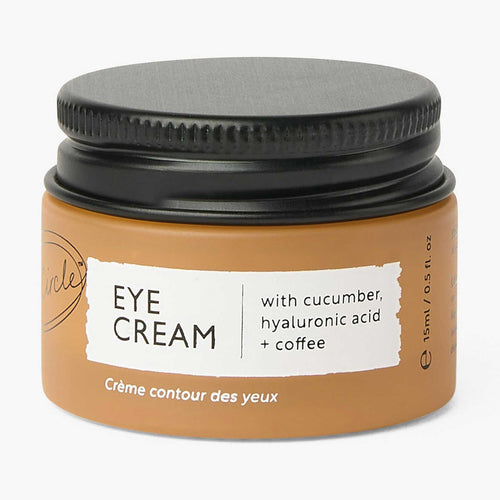
Maple bark is a by-product of syrup production and appears in our Eye Cream with Hyaluronic Acid and Coffee. We have written up the ingredient in detail in our guide to maple bark skincare benefits. Chai spices come from a London chai company, collected once the spice mix has finished steeping. If you want the formulation team's own account of how a stream gets chosen, that is in how upcycled ingredients are chosen. A running list of what we repurpose sits on our ingredients page.
Our B Corp score, and what the number means
UpCircle holds a verified B Corp score of 107.2. That is the figure most worth publishing, because unlike a tonnage we calculate ourselves, it is verified by a third party against a fixed standard.
Some context for the scale. The B Impact Assessment runs to over 200 questions across five areas: governance, workers, community, environment and customers. The pass mark for certification is 80 points. The median score for an ordinary business that completes the assessment is 50.9. We first certified in 2022 on a score of 96.3, after a process that began in March 2022 and took just under nine months, and we wrote about that at the time in we are now a certified B Corporation. Our current 107.2 reflects the progress made since.
Scale of the movement, as we reported it in 2022: over 100,000 businesses had signed up to take the B Impact Assessment since its launch in 2006, and around 3,500 were certified. Those figures are three years old now and the movement has grown, so treat them as a snapshot rather than a current count. The standards themselves are published by B Lab UK, and our own breakdown lives on our B Corp page and in what makes UpCircle a B Corp certified brand.
The plastic numbers, dated honestly
Our most recent published corporate social responsibility report covers 2023, and every figure in this section carries that date. In 2023, UpCircle's funding helped recover 2,636kg of ocean-bound plastic, which the certifying body calculated as the equivalent of more than 146,000 plastic bottles. The material recovered is multi-layered plastic, which has no commercial recycling value and would not have been collected without funded intervention.
The same 2023 report recorded donations to 18 charities and five campaigns run in line with social issues, seven additional employees hired that year, and more than 350 new stockists and retailers, alongside a 28% increase in customers against the previous year. The full document is linked from our 2023 corporate social responsibility report post.
We are not going to present 2023 figures as if they were 2026 figures. A 2024 and 2025 update has not been published in the same format, which means the honest statement is that our most recent verified plastic recovery number is three years old. If you are auditing us, that is a fair thing to hold us to.
How to read any brand's impact numbers, including ours
The most useful skill in this category is not knowing our numbers. It is knowing which questions turn a claim into a checkable fact. Here is the test we would want applied to us.
| Question to ask | A weak answer | A checkable answer | How UpCircle answers it |
|---|---|---|---|
| How much? | "Tonnes of ingredients saved" | A specific figure with a unit and a start date | Over 400 tonnes, cumulative since 2016 |
| From where? | "Sustainably sourced" | Named producers or named industries per stream | Five named streams, from named cafes, oil producers and food processors |
| Verified by whom? | Self-declared, no assessor | A third-party standard with a published score | B Corp certified, verified score 107.2 |
| As at when? | No date given | Each figure carries the year it was measured | Tonnage cumulative to 2026; plastic figures dated 2023 |
| What is missing? | Gaps not mentioned | The brand names what it cannot yet measure | No published emissions figure, no 2024 to 2025 plastic update |
Read down the last column and you get a fair picture: strong on sourcing and certification, incomplete on carbon and on recency. In the UK, the Competition and Markets Authority sets out what a defensible environmental claim looks like in its Green Claims Code, which is a useful yardstick to hold any beauty brand against, ours included. Our guide to decoding certifications covers the labels themselves.
What we deliberately do not count
Three things we leave out, because including them would inflate the story without adding evidence.
We do not count material we handled but did not formulate. Grounds that arrive in poor condition are composted, and composting is a sensible outcome, but it is not a rescued ingredient and it does not go into the tonnage.
We do not count the surplus our suppliers avoid downstream. When a chai company stops paying for disposal because we buy the spices, that is a real change in their operation. It is also their number, not ours, and we have no way to verify it.
We do not count future capacity as achieved impact. A stream we are trialling is a trial. It joins the figure when material has actually been collected and formulated.
Does any of this cost you performance?
No, and this is the part of the argument we care most about. A rescued raw material has to clear the same efficacy bar as a freshly farmed one before it goes anywhere near a formula. If it does not perform, the sustainability story cannot rescue it.
The clearest evidence we have is our Peptide Serum with Custard Apple and Blood Orange, which was clinically tested and shown to improve skin elasticity by 29% over 14 days. It is formulated with upcycled fruit waters and extracts. The number came from the testing, not from the sourcing, which is exactly the order those two things should sit in. For what that phrase should and should not mean on a label, see what clinically proven means in skincare, and for the broader science, are upcycled ingredients effective.
Where the Discovery Set fits into all this
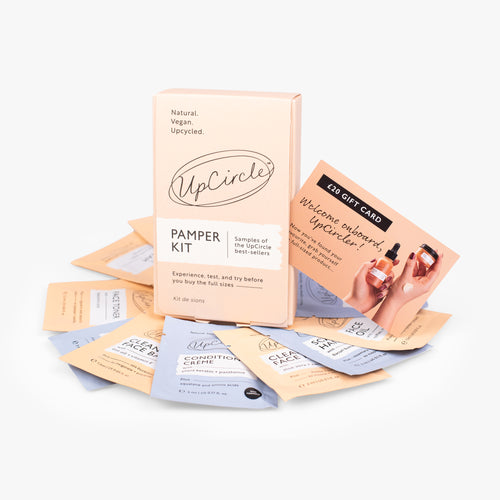
If you want to test the argument on your own skin rather than take our word for it, The Discovery Set is the lowest-commitment way in. It holds three travel sizes: the Cleansing Face Milk with Oat Powder at 50ml, the Face Moisturiser with Vitamin E at 30ml, and the Peptide Serum at 15ml. Worth £34.97 bought separately, it is £29.49 as a set, a saving of 15%.
Each of the three contains a repurposed ingredient, and each arrives in recyclable packaging: a glass bottle, a jar or an aluminium tube. The Cleansing Face Milk is 99% natural and built around upcycled oat powder. That is the whole thesis compressed into three small bottles: rescued input, tested output, packaging you can actually put in a kerbside bin.
Frequently asked questions about circular beauty impact
How many tonnes of ingredients has UpCircle rescued?
More than 400 tonnes of surplus material from the food and drink industry, cumulative since the company started in 2016. The figure covers five named streams: spent coffee grounds, argan shells, apricot stones, maple bark and chai spices. It counts material that was collected, processed and formulated into finished products.
What is UpCircle's B Corp score?
107.2, verified against the B Impact Assessment. We first certified in 2022 with a score of 96.3. The certification threshold is 80 points and the median score for an ordinary business completing the assessment is 50.9. The assessment covers governance, workers, community, environment and customers across more than 200 questions.
How much plastic has UpCircle removed from the environment?
Our 2023 corporate social responsibility report, the most recent one published, recorded 2,636kg of ocean-bound plastic recovered through our funding, which the certifying body equated to more than 146,000 plastic bottles. That figure is specific to 2023 and has not been updated in the same format since, so we date it rather than present it as current.
Is circular beauty impact the same as being carbon neutral?
No. Circular beauty impact measures material kept in use rather than extracted new. Carbon neutrality measures emissions balanced against removals. A brand can divert a lot of material and still have a significant carbon footprint. We do not publish a carbon figure because we do not have one we would stand behind, and we would rather say that than approximate.
How can I check a beauty brand's sustainability claims myself?
Ask five questions: how much, from where, verified by whom, as at when, and what is missing. A claim that survives all five is a fact. A claim that answers none of them is copywriting. The Competition and Markets Authority's Green Claims Code sets out the same principle in more detail for UK businesses.
Do rescued ingredients work as well as conventionally sourced ones?
Yes, and in some cases better, because a by-product is often the part of the plant that retains the compound you want. Spent coffee grounds keep caffeine and antioxidants after brewing, and argan shells hold vitamin E that oil pressing never reaches. Efficacy comes from the active and the formulation, not from the origin of the raw material.
About this report
UpCircle is a UK circular beauty brand founded in 2016 by siblings Anna and Will Brightman, built on rescuing surplus ingredients from food and drink production and formulating them into skincare. We are a certified B Corporation with a verified score of 107.2, assessed across governance, workers, community, environment and customers.
Every figure in this article is drawn from one of four places: our published corporate social responsibility report for 2023, our B Corp assessment, our own product testing, or our live product and ingredient pages. Where a figure carries a date, we have given it. Where we do not have a figure, we have said so rather than estimated one. If you find a number here you think is wrong, we would genuinely like to hear about it.
Where to go next
- Read on: start with what is circular beauty for the definition behind the numbers, then why we use rescued ingredients for the sourcing detail.
- Explore the range: browse the full skincare collection to see which rescued ingredient sits behind each product.
- Try it: The Discovery Set puts three of our most-used formulas in travel sizes for £29.49, so you can judge the efficacy argument for yourself before committing to full sizes.