







Jump to: What rescued ingredients actually are · Why they often work better · A supply chain you can actually name · What the cost economics let us do · What we don't do · Rescued vs typical natural ingredients · The five products and what they rescue · 400 tonnes, and what that actually means · FAQ
If you've read enough beauty marketing to spot the patterns, you'll know the script. "Sustainably sourced." "Ethically harvested." "Eco-conscious formulation." A lot of it is window dressing on a supply chain nobody at the brand has ever actually traced. We started UpCircle in 2016 with a different question, and it had nothing to do with marketing.
The question was: what happens to the coffee grounds at the cafe we walked past every morning? It turned out the answer was several tonnes a week, into landfill, where they emit methane. The grounds were also full of caffeine and antioxidants that the brewing process leaves almost entirely behind. So we started collecting them. Eight years later we still build our products around rescued ingredients, and we want to be honest about why. The reason isn't virtue. It's that they're often better than the freshly extracted alternative, and the supply chain is by definition more transparent.
Key takeaways
- Byproduct ingredients often retain higher concentrations of bioactive compounds than the primary product they're separated from. Spent coffee grounds keep most of their caffeine and antioxidants after brewing, and argan shells contain vitamin E that's discarded as waste during oil extraction.
- Rescued supply chains are traceable by definition. We can name the cafes our coffee comes from, the chai company our spices come from, and the named producers behind our argan shells, our maple bark, and our apricot stone powder. Most "ethically sourced" ingredients can't be traced beyond a broker.
- The cost economics matter. A rescued raw material is cheaper than a freshly farmed one of equivalent quality, which lets us spend more on the rest of the formulation, the testing, and the packaging.
- To date we've rescued over 400 tonnes of would-be waste from the food and drink industry. That's the byproduct of building products that work, not the reason we built them.
What rescued ingredients actually are
A rescued ingredient is a raw material that would otherwise have been discarded, but is collected, processed, and formulated into a finished product. The phrase covers a wider category than most people assume: the spent grounds left after brewing coffee, the shells left after pressing argan oil, the bark stripped from trees during maple syrup production, the apricot stones discarded by jam factories, the chai spices left after the chai itself has been sold. Some are food and drink byproducts; some are agricultural offcuts; some are industrial waste streams that nobody had thought to look at.
The word "rescued" matters more than the word "upcycled," even though we use both. Upcycling implies craft. Rescue implies an active choice to intercept something that was already heading for landfill or incineration, and to find a use for it that genuinely benefits the end product. Both are true for what we do, and we've written more about how the formulation team picks which streams are worth chasing in our piece on how upcycled ingredients are chosen.
The other thing worth saying is that rescued does not mean lesser. We don't accept inferior raw materials and dress them up. Every byproduct stream we use has to pass the same internal screen as a freshly farmed ingredient: efficacy first, then cost, then traceability, then waste impact. If a rescued source isn't strong on the first criterion, we don't use it.
Why rescued ingredients often work better
The single biggest misconception about rescued ingredients skincare is that the rescue is a moral choice with a cosmetic cost. It isn't. In several of the most useful categories, the byproduct is the more bioactive part of the source plant, and the primary product is the part that's been stripped of what we want. Three concrete examples.
1. Coffee grounds keep most of their caffeine
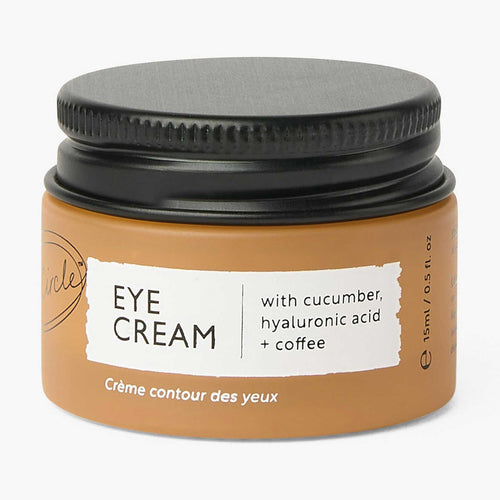
Brewing coffee extracts flavour compounds, oils, and a portion of the caffeine into the cup. What it doesn't do is exhaust the grounds. Studies of spent coffee grounds have repeatedly shown they retain a meaningful percentage of their caffeine content along with most of their antioxidant chlorogenic acids, because the extraction process is selective rather than complete. Topical caffeine penetrates the skin and acts on the local microcirculation, narrowing capillaries and reducing fluid pooling. That's the mechanism behind the depuffing effect of our Eye Cream with Hyaluronic Acid + Coffee, and it's also why caffeine is the active in our Face Scrub with Coffee and our Body Scrub with Coffee + Lemongrass.
The honest framing is that we get a better caffeine-rich raw material from a London cafe at the end of its life than we would by buying freshly milled green coffee at the start of one. The cafe gets a waste stream collected for free; we get an ingredient that's already done part of its journey. We've written more about the science of caffeine on the skin in our caffeine for hair and skin piece.
2. Argan shells contain vitamin E that the oil industry throws away
Argan oil is pressed from the kernel inside the argan stone. The hard shell that surrounds the kernel is, in conventional argan oil production, a waste stream. It's also rich in vitamin E and other tocopherols that the oil extraction misses. We mill that shell into a fine powder and use it in our Face Moisturiser with Vitamin E, where the vitamin-E content of the shell-derived powder genuinely contributes to the antioxidant load of the product. Vitamin E supports the skin barrier, neutralises free-radical damage, and helps protect the lipid layer that holds moisture in.
The point isn't that the shells are equivalent to the kernels. They're not. The point is that the shells contain a useful active that nobody bothered to extract before, and the rescued supply lets us put that active in front of the customer at a price that allows us to invest the saving back into the rest of the formula.
3. Maple bark, apricot stones, chai spices
The same pattern shows up across the wider rescued list. Maple bark is rich in polyphenols that the syrup industry strips out as a byproduct, and we use it in the Eye Cream because it has been clinically demonstrated to support skin barrier strength against blue-light-induced oxidative stress. Apricot stones, the hard inner pit left after jam and juice production, mill into a gentle physical exfoliant that's softer on the skin barrier than the cracked-walnut-shell scrubs of the 1990s, and we use a fine apricot stone powder in our Cleansing Face Balm. Spent chai spices, collected from a London chai company after the spice mix has steeped its drink, retain warming antioxidant compounds we use in our limited-edition body scrub formulations.
None of these claims is unique to rescued sourcing. What is unique is that the rescued route is generally where the better-priced, better-traced, and (in several cases) more bioactive material lives. The rescue isn't despite efficacy. It's the route to it.
A supply chain you can actually name
The second reason we use rescued ingredients is the supply chain itself. "Ethically sourced" is a phrase we don't use, because it tends to be an opaque claim that nobody at the brand can defend if pressed. Most ingredient brokers in the cosmetics industry sit at least three steps removed from the farm, and most beauty brands sit one further step removed from the broker. By the time the ingredient reaches the formulation lab, the chain of custody has gone through enough hands that "ethical" is more aspiration than fact.
Rescued ingredients short-circuit this. By definition, they come from a named industrial process, not a generic agricultural source. We can tell you the cafes our coffee comes from. We can name the chai company our spices come from. The argan shells come from a specific argan oil cooperative we've visited. The maple bark comes from a named syrup producer. The apricot stone powder is sourced as a documented byproduct of a specific food-processing operation. There's no broker in the middle whose claims we have to take on trust.
That traceability has knock-on effects. It lets us audit. It lets us answer customer questions truthfully. It lets us stand by certifications that depend on supply-chain documentation, including our B Corp certification, which requires verified evidence on supplier conduct, environmental impact, and waste flows. A typical "ethically sourced" claim cannot survive that level of audit. A rescued claim can. We've shared the full thinking behind our sourcing principles on our about us page.
What the named-source approach looks like in practice
The cafe partnership for our coffee grounds is the longest-running. We collect spent grounds from a network of independent London coffee shops, processed in batches at our UK facility, and use them across the Eye Cream, the Face Scrub, and the Body Scrub. The grounds we don't use directly are composted. The cafes we collect from get a waste-removal service for free, and a small co-marketing badge for the customers who care that the place where they buy a flat white is also part of the story behind a product they use at home.
The argan shell partnership is run with a Moroccan oil producer who, before we started buying their shell stream, was paying to dispose of it. The chai partnership is the same shape: spices that were costing the chai company money to dispose of are now an income stream. The economics work for both sides because the rescued material is genuinely valuable to us, and genuinely a cost line for the partner without us.
What the cost economics let us do
The third reason we use rescued ingredients is more pragmatic, and we don't think we should hide it. A rescued raw material is generally cheaper than a freshly farmed one of equivalent quality. That cost saving doesn't go to margin. It goes to the rest of the formulation.
Three places it shows up. First, the supporting actives. When the headline ingredient is rescued, we have budget to add hyaluronic acid, niacinamide, peptides, and the supporting plant oils that turn an ingredient story into a formulated product. Our Face Moisturiser has eighteen ingredients on the INCI, not three, and that's because the argan shell saving lets us put real money into shea butter, jojoba oil, and the rest of the supporting cast.
Second, the testing. Independent skin-irritation and skin-barrier testing is expensive. It's also non-negotiable for anything we put on the market. Rescued sourcing means we have the budget to test every formula with an independent dermatology lab, including patch testing with sensitive-skin panels, before launch.
Third, the packaging. Glass jars, aluminium lids, and the higher unit costs of recyclable formats are funded in part by the cost saving on the raw material. The full circular story isn't just the rescued ingredient; it's the rescued ingredient making the packaging story affordable as well. If you'd like to see the rest of the rescued range in one place, the face care collection is the cleanest entry point.
What we don't do
It feels worth saying what we deliberately avoid, because it's the thing that turns rescued sourcing from a marketing claim into a real positioning.
1. We don't lead with virtue
If you read our product pages, the rescued story is rarely the first sentence. The first sentence is what the product does for skin. The rescue comes in as the differentiator, not the lead, because if a product doesn't work, the rescue is a pity, not a purchase. The full thinking on this is in our piece on natural vs organic, where we make the same argument about the natural label.
2. We don't use vague green language
"Eco." "Green." "Toxin-free." "Chemical-free." All of these are either meaningless or actively misleading. Skin is chemical. Water is chemical. The toxic dose is the dose, not the source. We avoid the language because we'd rather earn the trust of the customer who notices when language is sloppy than win the customer who only reads the front of the bottle.
3. We don't pay lip service to circularity
Circularity isn't a label we'd pin to a non-circular product to make it sound better. It's the thing the formulation team optimises for from day one. Subscribe & Save is part of that, because a product that's part of a regular delivery rhythm has a lower carbon and packaging cost per use than the same product bought in a one-off pulse.
4. We don't claim what we can't substantiate
Specific numbers, where we have them. "Rescued 400 tonnes" not "rescued lots." "Clinically proven 29% improvement in elasticity in 14 days" for the peptide serum, with the test report on file, not "amazing results." If a claim can't be defended with a number, we don't make it.
Rescued vs typical natural ingredients, side by side
The simplest way to see the difference is to lay it out. This is what a typical "natural" beauty supply chain looks like, and what the rescued version looks like, on the four axes that matter.
| Criterion | Typical "natural" supply chain | Rescued ingredient supply chain |
|---|---|---|
| Traceability | Broker-mediated, often three or more steps removed from the farm. Origin claims rest on supplier statements, not first-hand audit. | Named industrial source: specific cafe, named oil producer, named chai company. Documented byproduct flow. |
| Bioactive retention | Depends on the extraction method, often optimised for the primary product. Useful actives may be discarded with the byproduct. | Often higher in the byproduct than the primary product, because the primary process strips what we want for skin. |
| Waste impact | Net-positive land use at best. Generates packaging and processing waste. | Net-negative: diverts a waste stream that would have gone to landfill, compost, or incineration. |
| Cost economics | Premium price for "natural" labelling, often funded by reducing investment in the rest of the formulation. | Lower raw-material cost, reinvested into supporting actives, independent testing, and circular packaging. |
If you read across the four rows, the differences compound. None of them is the headline reason on its own; together they describe a different way of building products. We've written more on what we believe and don't believe in our piece on debunking ten common skincare myths.
The five products and what they rescue
The clearest way to see the principle in action is to walk through the products that the rescued story is built around.
1. Eye Cream with Hyaluronic Acid + Coffee
Two rescued sources. Coffee oil from grounds collected at London cafes, used for its caffeine and antioxidant content, and maple bark sourced as a byproduct of maple syrup production, used for its polyphenol and barrier-supporting compounds. The supporting ingredients are hyaluronic acid for hydration, cucumber for soothing, and chamomile and calendula for calming. We've written the full ingredient logic in our best eye cream for dark circles UK guide.
2. Face Scrub with Coffee + Rosehip Oil
Spent coffee grounds at the centre, providing physical exfoliation and topical caffeine in the same step. Rosehip oil for unsaturated fatty acids and natural vitamin C activity. Sugar for additional gentle exfoliation. The grounds are the same network we collect from for the Eye Cream, prepared at a coarser grind for body and face exfoliation.
3. Body Scrub with Coffee + Lemongrass
The original UpCircle product. Spent coffee grounds and lemongrass for an awakening, citrus-warm scrub. The body version uses a slightly coarser grind than the face scrub because body skin tolerates a more robust physical exfoliant. The collection is sized for shower use, and the company started, eight years ago, with this single SKU.
4. Face Moisturiser with Vitamin E
Argan stone powder, milled from the shells diverted from argan oil production, contributes most of the vitamin E. Supporting actives include shea butter, jojoba oil, and the rest of an eighteen-ingredient INCI focused on dry and dehydrated skin. The moisturiser is a daily product and is currently part of our Dry Skin Bundle.
5. Cleansing Face Balm
Apricot stone powder, milled from the pits left after jam and juice production, used at low percentage for gentle exfoliation as the balm dissolves into oil on the skin. Supporting cast: olive squalane, vitamin E, and a blend of plant oils to lift makeup and pollution without stripping the barrier. The balm is the front of our cleanse-and-moisturise routine.
400 tonnes, and what that actually means
One number we will quote, because we have the receipts. To date we have rescued over 400 tonnes of would-be waste from the food and drink industry, including coffee grounds, argan shells, apricot stones, chai spices, and maple bark. Four hundred tonnes is roughly the weight of forty London buses. It's a number we add to every year, and the rate of addition is growing as the rescued range grows.
What it isn't is the reason you should buy our products. The reason you should buy them is whether they work for your skin. The 400 tonnes is the byproduct of building products that work, with rescued raw materials that happen to be the more bioactive, more traceable, and more cost-efficient route to the same finished product. If a product doesn't earn its place on its own merits, the rescue can't justify it. We've made that mistake in earlier formulations and we don't make it any more. Industry analysis projects the upcycled ingredients market to grow at over 5% a year through the next decade, but the brands that win the long term will be the ones whose rescued products work as well as anything else on the shelf.
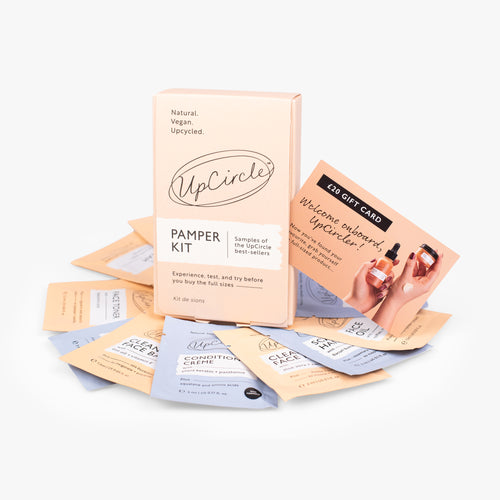
If you're new to the rescued range and want a low-friction way to start, the Subscribe & Save programme drops your most-used product into a regular rhythm, lowers the per-unit cost, and reduces the carbon and packaging cost per use. If you'd rather try a curated range first, the Pamper Kit is a sampler of the rescued formulas at a smaller commitment.
Frequently asked questions about rescued ingredients
What does "rescued ingredients" actually mean?
A rescued ingredient is a raw material collected from a waste or byproduct stream that would otherwise have been discarded, then processed and formulated into a finished product. UpCircle rescues coffee grounds from London cafes, argan shells from oil production, apricot stones from jam factories, maple bark from syrup production, and chai spices from a London chai company.
Are rescued ingredients as effective as freshly extracted ones?
Often more effective. The brewing process leaves most of the caffeine and antioxidants in spent coffee grounds, and argan shells contain vitamin E that's discarded during oil extraction. The byproduct is sometimes the more bioactive part of the source plant, not the inferior part.
Why don't more brands use rescued ingredients?
The supply chains take longer to set up. A rescued source is a partnership with a specific food or drink producer, not a phone call to a generic ingredient broker. It's also a different procurement model that doesn't fit the standard cosmetics-supply assumptions. We've spent eight years building the relationships, and that's part of the moat.
Is "rescued" the same as "upcycled"?
Close, but not identical. Upcycled emphasises the craft of turning a waste stream into a higher-value product. Rescued emphasises the active choice to intercept a stream that was already heading for landfill or incineration. Both are accurate for what we do, and we use both depending on context.
Can rescued ingredients be certified organic?
Yes, when the source farm is certified, although the certification logic is different. A rescued ingredient inherits the practices of the upstream production it comes from, and the documentation has to flow through the byproduct partner. We list the certifications on the relevant product pages rather than making a blanket claim.
How does using rescued ingredients affect the price of the product?
It generally lowers the raw-material cost, which we reinvest into supporting actives, independent testing, and recyclable packaging rather than pocket as margin. The retail price is set by the value of the finished product, not by the cost of the rescued ingredient inside it.
What about the supply chain? Is it really traceable?
Yes. Each rescued ingredient comes from a named industrial process: specific cafes, a named oil cooperative, a named chai company, named food-processing operations. The chain of custody is documented as part of our B Corp certification audit and as part of our internal supplier records. Most "ethically sourced" claims in conventional cosmetics cannot meet that standard.
Has UpCircle really rescued 400 tonnes of waste?
Yes, to date, across the full rescued range. The number is updated annually as the range grows. It's the byproduct of building products that work, not the headline reason to buy them.
About this guide. This article was written for UpCircle, a B Corp certified circular beauty brand based in the UK. Our products are 99% natural, vegan, cruelty-free, and made with rescued ingredients diverted from food and drink production. To date, UpCircle has rescued over 400 tonnes of would-be waste from landfill. Every claim in this article traces back to either published research, our own clinical or independent-lab testing, or the formulation team that built the product.
Where to start with the rescued range.
- Begin with the Body Scrub with Coffee + Lemongrass, the original rescued-coffee product the company was built around.
- Or take our two-minute skin quiz for a routine matched to your skin and concerns.
- Save 15% on any of the rescued formulas via Subscribe & Save, the lowest-impact way to keep them in rotation.