







Jump to: What circular skincare actually means · 1. Look for named ingredient sources · 2. Look for named supply-chain partners · 3. Look for measurable rescue figures · 4. Look for certifications that demand evidence · 5. Look for a real packaging loop · Vague green claims vs verifiable circular claims · A worked example: how UpCircle stacks up · A two-minute shopping checklist · FAQ
If you've gone looking for upcycled skincare brands UK shoppers can trust, you've probably noticed something frustrating. Almost every brand now describes itself as sustainable, circular, ethical, or low-waste, and the words have started to mean very little. We hear from customers who want to shop circular but feel like they need a chemistry degree and a forensic audit to tell genuine practice from green dressing on the box.
This is the honest guide we'd write for a friend asking for the smell test. Not a list of brands ranked best to worst, because reputations shift and we don't want to misrepresent anyone, but the five things worth checking before you trust any "circular" or "upcycled" claim, with our own supply chain as a worked example you can hold every other brand up against.
Key takeaways
- A genuinely circular skincare brand will name its ingredient sources by partner, not just by adjective. "Rescued coffee grounds from London cafes" is verifiable. "Ethically sourced botanicals" is not.
- The strongest signal of real circular practice is a measurable, audited waste-rescue figure. UpCircle has rescued more than 400 tonnes of would-be-waste ingredients since 2016, a number that grows each year and is published in our impact reporting.
- Trust certifications that require third-party evidence: B Corp, Soil Association, Leaping Bunny, EWG Verified. Be sceptical of self-declared labels like "clean", "non-toxic", "eco-friendly", which have no auditing body behind them.
- Packaging is circular only if the loop closes in real life, not in theory. Glass and aluminium that go in your kerbside recycling are real; "technically recyclable" plastics that need a brand-specific mail-back scheme are mostly aspirational.
What circular skincare actually means
Circular skincare means the brand has designed waste out of the supply chain on purpose, not as an afterthought. A linear supply chain takes virgin raw materials, turns them into product, and lets the leftovers become someone else's problem. A circular one starts somewhere downstream of that, using by-products and rescued materials that would otherwise have gone to landfill or compost, and finishing with packaging that has a credible second life. The word "upcycled" is the ingredient-side of that idea, taking a material that is finished doing one job and giving it another.
The trouble is that "circular" has become a marketing word as well as a technical one. A brand can buy in argan oil from a virgin pressing operation and still call itself "natural and circular" because its carton is made of recycled cardboard. That isn't dishonest exactly, but it isn't what most shoppers think they're paying for. If you want a deeper read on the ingredient side, our product developer's view of how upcycled ingredients are chosen walks through what we look for when we evaluate a new rescued material.
Five things, taken together, separate brands that have designed circularity in from brands that have bolted the language on. None of them is perfect on its own. All five together is a good signal.
1. Look for named ingredient sources
The single best signal of a genuinely circular brand is whether the ingredient origin is named, or whether it hides behind an adjective. Real upcycled supply chains are specific. Vague language is almost always a sign that the brand is buying off-the-shelf "natural" extracts from a wholesale ingredient catalogue and dressing them up in the marketing.
1. What to look for on the label or product page
You're looking for a sentence that names the source by category and, ideally, by partner. "Rescued chamomile from herbal tea production" is good. "Argan stones diverted from oil pressing in Morocco" is better. "Spent coffee grounds from London cafes" is best, because the geography and the type of business are both nameable. If the page says "ethically sourced botanicals" and stops there, the brand is either not buying upcycled material at all, or is unwilling to say where it comes from.
2. What to ask if you're not sure
It is fair to email a brand and ask "where do the upcycled ingredients in this product come from, and from which partner". A brand with a real circular supply chain will answer in a paragraph. A brand without one will send marketing copy back. We've answered that question in writing for journalists, retailers, and curious customers thousands of times. Our hero ingredients trace to specific by-product streams: coffee from cafes in London, argan stones from oil production in Morocco, chai spices from a London-based chai company. You can read more about how those rescued coffee grounds become the active in our skincare.
3. Why generic claims fail this test
"Natural", "clean", "sustainable", and "upcycled" are not regulated words in cosmetics, which is why specificity is the only check you can rely on. If the brand can name the source, the source exists. If it can't, you're paying for a story that may not have a supply chain behind it.
2. Look for named supply-chain partners
The second test is whether the brand can name the actual businesses on the other end of the rescue, not just the category of business. A circular supply chain depends on relationships with the producers who would otherwise have thrown the by-product away. Those relationships are public-facing in any honest brand, because they're a competitive advantage and a story worth telling.
1. The cafes, producers, and food companies
Look for named partner businesses. The kind of detail you should be able to find on a brand's website includes the city, the type of business, and ideally the partner's name. We've worked with London-based cafes since 2015 to collect their spent coffee grounds, and we've published photos, partner interviews, and supplier visits to back it up.
2. Why this matters more than it looks
Wholesale ingredient suppliers will sell you "upcycled coffee oil" by the litre with no traceability beyond their own warehouse. A truly circular brand has its own collection or partnership upstream of that, which is the part that's expensive and difficult and meaningful. A brand that buys finished upcycled extract from a wholesaler still gets to use the word "upcycled", but isn't doing the systems-design work that makes the supply chain genuinely circular. Our natural vs organic explainer goes deeper on the difference between regulated and marketing terms.
3. Look for measurable rescue figures
The third test is whether the brand publishes numbers, or whether it talks in adjectives. A measurable waste-rescue figure (in tonnes, kilograms, or units per year) is the most honest indicator of scale. Numbers are auditable. Adjectives are not.
1. The number itself
Look for "X tonnes rescued" or "Y million units diverted from waste" or "Z hectares regenerated", with a year attached. A specific, growing number tells you the impact is real and the brand is tracking it. We've rescued more than 400 tonnes of would-be-waste ingredients since 2016, and the figure grows every year. Our about page carries the current total, and we update it annually rather than letting it drift.
2. The audit trail
The strongest version of this is a number with a method behind it. Brands with serious impact reporting publish how they count, what they include, and what they exclude. Less rigorous brands publish a round number with no backup. The presence of an annual impact report, an independent verification statement, or a B Corp Impact Score is a strong signal that the number is real.
3. Why "we use upcycled ingredients" alone isn't enough
A brand could use one upcycled ingredient at a fraction of a percent in one product and still claim to "use upcycled ingredients". That's not a lie, but it isn't circular by design either. A measurable scaling figure is what separates a brand whose entire range is built around rescued materials from a brand that has put one upcycled extract into one product as a marketing flourish. Our whole philosophy on this is laid out in our brand story.
4. Look for certifications that demand evidence
The fourth test is whether the brand carries certifications that require auditable proof, or whether it leans on labels that anyone can self-apply. A real certification is a signal that an independent body has examined the brand's practices. A self-declared label is just the brand's own marketing.
1. Certifications that mean something
The labels worth weight are the ones with public standards and renewal audits. B Corp requires a 200-point assessment across governance, workers, community, environment, and customers, and recertification every three years. The Soil Association certifies organic and natural beauty against published criteria. Leaping Bunny audits cruelty-free supply chains. EWG Verified looks at ingredient transparency. Each of these is something a brand has to earn and keep earning.
2. Self-declared labels to be sceptical of
"Clean", "non-toxic", "chemical-free", "natural", and "eco-friendly" all sound reassuring, but none of them has a regulating body behind them. Any brand can use any of these words on any product without independent oversight. That doesn't make them automatically dishonest, but it does mean they are not evidence. The word that should always make you check more carefully is "natural", because it's the most heavily marketed and the least regulated. We've written about the most common skincare myths if you want a deeper read on the language.
3. UpCircle's certifications
We are a certified B Corp, which means our entire business has been independently scored and verified against the B Lab standards. Our products are vegan and cruelty-free. Our impact is in our annual reporting, not just on the box. The B Corp certification is the one we'd argue is the highest-evidence label in beauty today, because it audits the company, not just one product line, and it's renewable.
5. Look for a real packaging loop
The fifth test is whether the brand's packaging closes the loop in real life, or whether it closes only in theory. The honest version of "recyclable packaging" is packaging your council collects from your kerbside. The dishonest version is "technically recyclable in a specialist facility nobody has access to", or "recyclable if you mail it back to us, which most customers never do".
1. What real packaging looks like
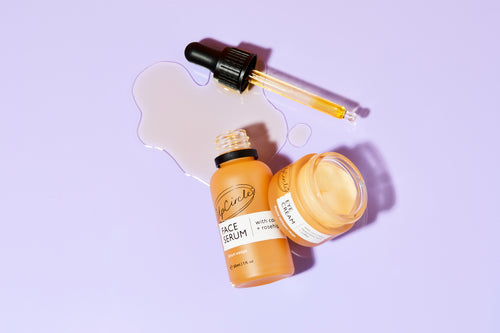
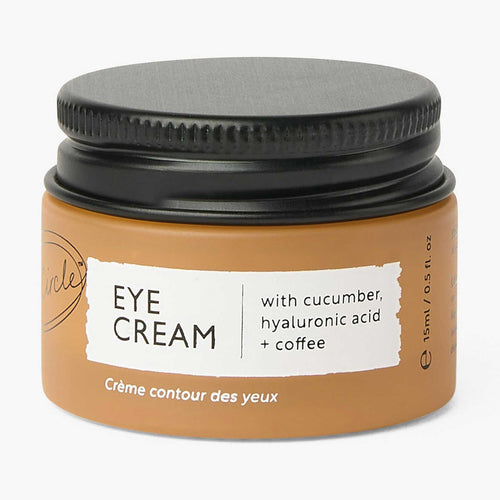
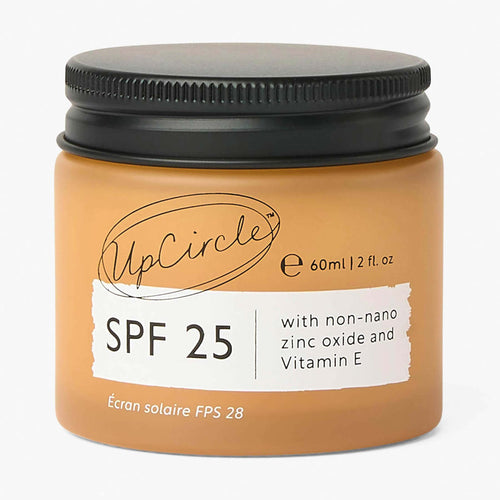
Glass jars, glass bottles, aluminium tins, and uncoated cardboard are recyclable in almost every UK kerbside scheme. They have an established secondary market. Recycled-content versions of these (post-consumer recycled glass and aluminium) close the loop on the production side too. Most of UpCircle's range, including our Eye Cream with Hyaluronic Acid + Coffee, our Face Scrub with Coffee + Rosehip Oil, and our Body Scrub with Coffee + Lemongrass, comes in glass with aluminium lids for exactly this reason. The loop closes in the kitchen.
2. What aspirational packaging looks like
"Recyclable in TerraCycle scheme X". "Recyclable if returned to a participating retailer". Soft-touch laminate plastics that local councils refuse but the brand calls "recyclable" anyway. None of these are lies on a strict reading, but the practical recycling rate of these formats sits in the low single digits. If a brand's whole packaging story depends on a return scheme, ask yourself what proportion of customers actually use it.
3. Subscribe to keep the loop tight
The packaging that gets recycled most reliably is the packaging that's already in your routine. A circular-purchase rhythm matters as much as a recyclable jar, because the loop only closes when the same customer comes back for more product in the same format. We're focused on Subscribe & Save as a low-friction circular-purchase model that customers actually stick with, which keeps the packaging-mass story tight without depending on return logistics. You can see the current options on our Subscribe & Save collection.
Vague green claims vs verifiable circular claims
If you put the two side by side, the difference is usually obvious in a sentence. Here's the same idea written two ways, with the marketing claim on the left and the verifiable circular claim on the right.
| Vague green claim | What it could mean | Verifiable circular claim | Why it's stronger |
|---|---|---|---|
| "Made with natural, sustainable ingredients" | Anything from one botanical extract to nothing measurable | "Made with rescued coffee grounds from London cafes, since 2016" | Names the source, the geography, the year |
| "Eco-friendly packaging" | Could be standard plastic with a green label | "Glass jar with aluminium lid, kerbside recyclable in UK councils" | Names the material and the recovery route |
| "Reducing waste" | Anything from real impact to none | "400+ tonnes of would-be-waste ingredients rescued to date" | Single auditable number with a baseline year |
| "Cruelty-free and clean" | Could be self-declared | "Leaping Bunny certified, B Corp certified" | Independent third-party audit |
| "Ethical and conscious" | Marketing language with no body behind it | "Score of X on the B Impact Assessment, recertified [year]" | Public score, public methodology, public renewal date |
If a brand's claim doesn't translate from the left column to the right, that doesn't automatically mean it isn't doing real work. It means you can't tell from the claim alone, and you'll need to dig before trusting it. Our piece on the most common skincare myths covers a few of the language traps in adjacent territory.
A worked example: how UpCircle stacks up
You can put any brand through the five tests above, including ours. Here's how we'd answer each one for our own range, in the same shape we'd want a competitor to answer.
1. Named sources and named partners
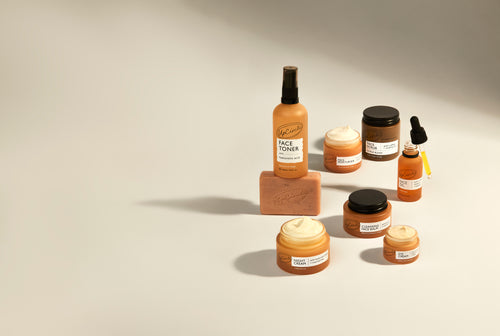
Spent coffee grounds rescued from cafes in London. Argan stones diverted from argan oil pressing in Morocco. Chai spices from a London-based chai company. Maple bark from maple syrup production. Each of these is named in the ingredient lists, not because we have to, but because the supply chain is the brand. Our hero range, including the Cleansing Face Balm with Vitamin E and the Face Moisturiser with Vitamin E, is built around these specific by-product streams. We've published partner stories, supplier visits, and photos from the cafes we collect from. The coffee partnerships are direct (we collect, we don't buy from a wholesaler reselling them) and have been the foundation of the brand since 2015.
2. Measurable rescue figures and real certifications
More than 400 tonnes of ingredients rescued from waste streams to date. The figure grows annually and is updated on the about page rather than left to drift. We are a certified B Corp, vegan, and cruelty-free. The B Corp assessment audits the whole business across governance, workers, community, environment, and customers, with mandatory recertification.
3. A real packaging loop
Glass jars and bottles with aluminium lids across the hero range, recyclable in standard UK kerbside schemes. Subscribe & Save offers a steady, low-friction circular-purchase rhythm that doesn't depend on a return logistics chain.
4. What we don't claim
We don't claim to be the only brand doing this. We don't claim every ingredient is upcycled (some, like the hyaluronic acid in our Eye Cream, are best-in-class standard skincare ingredients chosen for efficacy, and we say so). We don't claim "clean" or "chemical-free", because those words don't mean anything. The discipline is to be specific about what we do and don't do, and let the specificity be the trust signal.
A two-minute shopping checklist
If you're shopping circular and don't have time for a deep audit, this is the short version. Three minutes on a brand's website should be enough to answer most of these.
1. Can you find a named ingredient source and a named partner?
Not "natural", not "ethically sourced", but "rescued from X" or "diverted from Y production", with a partner business named somewhere on the site. If you can't find either in three clicks, the brand probably doesn't have one.
2. Can you find a number?
A rescued-tonnes figure, a packaging-mass-saved figure, a regenerative-hectares figure. Anything specific, ideally with a year on it. No number means no measurement.
3. Can you find a real certification logo with a registry link?
B Corp, Soil Association, Leaping Bunny, EWG Verified. Each has a public directory you can search to confirm the brand is currently certified. We're listed in the B Corp directory as UpCircle.
4. Can you recycle the packaging in your kerbside collection?
If yes, the loop closes. If the brand depends on a mail-back scheme, the loop only closes for the customers who post the packaging back. Most don't.
Four checks, three minutes, and you'll know more about a brand's real circular practice than the homepage marketing will tell you. If you want to start somewhere concrete, the face-care collection and body-care collection show the range we'd hold up against any of these tests.
FAQ
What's the difference between upcycled and recycled in skincare?
Recycled means a material is reprocessed into the same kind of material (a new bottle from old bottles). Upcycled means a material is repurposed into something of equal or higher value (coffee grounds going from cafe waste into a skincare exfoliant). In skincare, "upcycled" is most often used about ingredients; "recycled" is most often used about packaging.
Are there other UK upcycled skincare brands worth checking out?
There are several UK and UK-stocked brands working on circular ingredient supply chains, and we'd rather you assess them with the five-test checklist above than take our word for any specific name. The honest position is that we don't audit competitors and we don't want to misrepresent anyone, so we'd rather give you the tools to judge for yourself.
Is "natural" the same as "circular" or "upcycled"?
No. "Natural" describes the origin of an ingredient (plant-derived rather than synthetic). "Circular" and "upcycled" describe the supply chain (rescued or by-product rather than virgin). A brand can be natural without being circular, and circular without being entirely natural. The two are independent properties.
Does B Corp certification guarantee a brand is circular?
No, but it's a strong signal of overall ethics and impact discipline. B Corp audits the whole company across five areas (governance, workers, community, environment, customers), so a B Corp brand has at least been scored on environmental practice. Combine the B Corp signal with the named-source and named-partner tests for a fuller picture.
Are upcycled ingredients as effective as virgin ones?
In most cases, yes, and sometimes more so. Upcycled coffee oil contains the same caffeine and antioxidants as oil pressed from virgin beans. Argan stones from oil production are the same plant material as virgin argan stones. The "upcycled" part is about where the material came from, not what it does to skin. Our piece on how upcycled ingredients are chosen goes deeper.
How do I check a B Corp certification is current?
Search the brand's name on the public B Corp directory. Each entry shows the current status, the most recent recertification date, and the impact score. If a brand claims B Corp status but doesn't appear in the directory, the certification may have lapsed.
What if a brand doesn't publish numbers?
Email and ask. A brand with real impact data will be happy to send the figure or point you to a published report. A brand without it usually won't reply, or will reply with marketing copy. Both are useful answers.
Where do I start if I want to switch to a circular routine?
Start with the products you use daily and replace them one at a time as they run out. A circular cleanser, moisturiser, and eye cream cover most of a routine. Our skin quiz can suggest a starting point matched to your skin's needs, and our best eye cream for dark circles guide walks through how to read a single category critically.
About UpCircle. UpCircle is a certified B Corp skincare brand built on circular supply. We've rescued more than 400 tonnes of would-be-waste ingredients since 2016, including spent coffee grounds from London cafes, argan stones from oil production in Morocco, and chai spices from a London chai company. Every product is independently safety-tested, and our hero range is packaged in glass with aluminium lids, recyclable through UK kerbside collection.
If you want to start with the range that's been through every one of these tests, our Eye Cream with Hyaluronic Acid + Coffee is the most-loved product in the line, our product developer's guide to choosing upcycled ingredients shows how each one is selected, and Subscribe & Save keeps the loop tight on packaging while saving you 25% on every order.