





Jump to: What "clinically proven" actually means · The five tiers of skincare evidence · Ingredient-level vs finished-product testing · Sample size, who pays, and why both matter · What the data says vs what the marketing says · A worked example: our Peptide Serum 29% trial · How to read a clinical claim in 60 seconds · Our honest take on what we test, and what we don't · FAQ
If you've ever picked up a serum that promises a number, "47% smoother skin in seven days", "92% of users agreed", "clinically proven to do something miraculous", and felt your eyebrow lift, you're not being cynical. You're being literate. The phrase "clinically proven" has a useful technical meaning, and it has a much looser marketing meaning, and most beauty packaging trades on the gap between the two.
This guide is the one we'd write for a friend in the skincare aisle, holding two products and trying to work out which numbers actually mean something. We'll break down the five tiers of skincare evidence in plain English, explain why a 29% improvement in our own Peptide Serum trial is meaningfully different from "clinically proven" on a competitor's box, and give you a one-minute checklist for reading any clinical claim with the right kind of scepticism.
Key takeaways
- "Clinically proven" is not a regulated term in cosmetics. It can mean anything from a peer-reviewed randomised controlled trial to a 30-person consumer panel filling in a questionnaire, and brands rarely tell you which.
- The five tiers of skincare evidence, from least to most rigorous, are: in vitro (cells in a dish), ex vivo (skin samples), consumer perception panels, instrumented in vivo trials on humans, and peer-reviewed randomised controlled trials.
- Most "clinically proven" claims in beauty are at the consumer-panel or instrumented-in-vivo level. Peer-reviewed RCTs (randomised controlled trial) on finished cosmetic products are vanishingly rare because they cost six figures and take years.
- Our own Peptide Serum was clinically tested and improved skin elasticity by 29% within 14 days. That is a third-party instrumented in vivo finished-product trial, which sits at tier four out of five. It is not a peer-reviewed RCT, and we don't claim it is.
What "clinically proven" actually means in skincare
"Clinically proven" in skincare means a product was tested in a clinic-style setting and produced a measurable result, but that's about as far as the term takes you on its own. The phrase sits outside cosmetic regulation in both the UK and the US, which means there is no single definition a brand has to meet before printing it on a box. The FDA's cosmetics framework regulates safety and labelling rather than efficacy, and the UK's cosmetic regulations work on a similar principle. So the work of figuring out what a claim actually represents falls to the reader.
In practice, "clinically tested" or "clinically proven" usually signals one of three things: a panel of volunteers used the product for a few weeks and answered a questionnaire, an instrumented trial measured something on their skin with a probe, or, far more rarely, a randomised controlled trial published in a journal compared the product to a placebo. All three can be honest, and all three are different in what they can tell you about whether the product will work for you.
This is not a reason to dismiss every claim. It's a reason to ask one extra question every time you see a number on a box. We've talked about this before in our piece on 10 common skincare myths, and the same logic applies: numbers are useful, but the design of the test sitting behind the number is what makes the number meaningful.
The five tiers of skincare evidence, ranked by rigour
Not all clinical evidence is created equal, and the difference between the strongest and weakest types of testing is the difference between a peer-reviewed pharmaceutical study and a customer survey. This is the rough hierarchy used in cosmetic science, ordered from weakest to strongest.
| Tier | Test type | What it measures | Limitations | Typical cost |
|---|---|---|---|---|
| 1 | In vitro | Effect on cells, often human keratinocytes or fibroblasts in a petri dish | Skin is not a dish. Doesn't tell you the ingredient survives formulation, penetrates the barrier, or reaches the cells in real life. | £3k to £15k |
| 2 | Ex vivo | Effect on real skin samples kept alive in a lab | Closer to real biology but still no immune system, no microbiome, no use in context. | £10k to £30k |
| 3 | Consumer perception panel | Volunteers self-report what they noticed | Subjective. Subject to placebo effect, expectation bias, and the way the question is phrased. "92% agreed their skin looked smoother" is this tier. | £5k to £25k |
| 4 | Instrumented in vivo trial | A probe measures something on real human skin (elasticity, hydration, transepidermal water loss) before and after | Smaller sample sizes than RCTs, often no placebo arm, results not peer-reviewed. | £20k to £80k |
| 5 | Peer-reviewed randomised controlled trial | Treatment vs placebo, blinded, statistically powered, published | Rare on finished cosmetic products. Common on individual actives such as retinoids and topical caffeine. | £100k+ |
Most claims you see on beauty packaging sit at tier three or tier four. A "97% of users said" claim is almost always tier three. A specific number like "29% improvement in elasticity" or "66% reduction in dryness" is almost always tier four, because you need an instrument to produce a number like that. Tier five is what pharmaceutical drugs and a handful of well-funded skincare actives are tested at, and you can usually find the studies on the National Library of Medicine's PubMed database with a search.
1. In vitro: useful for early signals, weak as proof
An in vitro test puts an ingredient on cultured skin cells in a dish and looks for an effect. If a peptide doubles collagen production in fibroblasts, that's interesting and worth investigating, but it doesn't mean the same peptide will reach those cells in your skin once it's been formulated into a serum, packaged in a bottle, applied through a thin layer of moisturiser, and asked to penetrate the skin barrier. In vitro work is where ingredient development starts, not where finished-product evidence lives.
2. Ex vivo: better biology, still not a person
Ex vivo testing uses real human skin samples (often surgical leftovers) kept alive in a controlled environment. It's a step closer to how your skin actually behaves because it has the multi-layered architecture of real tissue. It still doesn't have an immune system, a microbiome, or daily life, so it tells you what the ingredient can do in principle, not what it does in your routine.
3. Consumer perception panel: subjective, easy to game
A panel of typically 30 to 100 volunteers uses the product for a defined period and answers a questionnaire. The famous "97% agreed" or "9 out of 10 said" numbers come from here. These claims are not lies, but they're sensitive to how the question is phrased ("did your skin feel smoother?" is different from "did your skin look measurably different from the control?"), and there's no placebo group to compare against.
4. Instrumented in vivo trial: what a credible "29%" looks like
This is what most well-resourced skincare brands mean by clinically tested. A panel of volunteers uses the product under controlled conditions, and a trained technician measures something specific on their skin, usually with a probe like a cutometer (for elasticity), a corneometer (for hydration), or a tewameter (for barrier function). The numbers are real, the measurement is reproducible, and the resulting claim has substance. But the panel is usually small, often there's no placebo arm, and the results aren't published anywhere a sceptic can review them.
5. Peer-reviewed randomised controlled trial: the gold standard
An RCT randomises participants into a treatment group and a placebo group, blinds both the participants and the people measuring the outcomes, and publishes the result in a journal where other scientists can pick it apart. This is the standard pharmaceutical drugs are held to, and it's vanishingly rare for finished cosmetic products. It's much more common for individual actives. Topical peptides have been studied in peer-reviewed work for collagen and elastin support, and caffeine has decades of peer-reviewed research behind its vasoconstrictor effect on skin.
Ingredient-level vs finished-product testing: the most-missed distinction
The most important distinction hiding inside any clinical claim is whether the testing was done on the active ingredient in isolation, or on the finished product as it actually arrives in your bathroom. They are not the same thing, and they can produce wildly different results. A standalone retinol study is not a study of the moisturiser the retinol ends up in, and the moisturiser's behaviour depends on the formulation as much as on the active.
Ingredient-level testing tells you what an active is capable of when it's at the right concentration, in the right vehicle, applied to the right kind of skin. It's how the cosmetic industry validates new actives. Finished-product testing tells you what the actual bottle on your shelf does to actual humans using it the way they'll use it. Both are useful, and both are honest, but a brand that conflates them is being slippery on purpose.
How to spot ingredient-level vs finished-product claims
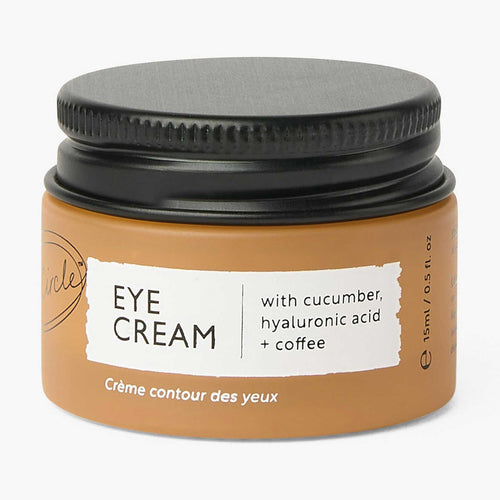
The wording usually gives it away. "Maple bark extract has been clinically demonstrated to support skin protection against blue-light-induced oxidative stress" is an ingredient-level claim, and that's the wording we use about the maple bark in our Eye Cream with Hyaluronic Acid + Coffee. We're saying the ingredient itself has clinical evidence for a specific mechanism. We are not saying the finished Eye Cream was tested for blue-light protection in a separate trial.
By contrast, "clinically proven to improve skin elasticity by 29% within 14 days" is a finished-product claim, and that's how we talk about the Peptide Serum. The trial used the actual finished serum, on volunteers, and measured a specific outcome with a specific instrument over a specific period. The two claim types live at different rigour levels even when both are honest.
Why ingredient-level is still useful
Most credible skincare claims are ingredient-level, and that's not a flaw. A finished-product trial costs a lot of money and a small brand can't run one for every product. What ingredient-level testing tells you is: this active does what we say it does, when it's used the way we're using it. It's a reasonable basis for a claim if the formulation respects the conditions the testing was done under.
The trap to avoid
The trap is the brand that runs ingredient-level testing in vitro on, say, 0.1% concentrations of an active, then puts 0.001% of that active into a finished product, and prints the in vitro result on the box. The wording can be technically defensible while being practically misleading. The fix, as a reader, is to look for the dose, the test design, and the medium. If those are missing, treat the claim as marketing rather than evidence.
Sample size, who pays, and why both matter
Two questions matter as much as the test type itself: how many people were in the panel, and who paid for the study. A 12-person panel funded by the brand selling the product is a very different piece of evidence to a 200-person independent panel measured by a third-party clinic. Both can produce a "29%" headline. Neither is automatically dishonest. They are different qualities of evidence, and the marketing rarely makes the difference visible.
Most published cosmetic trials run with 25 to 60 participants. That is enough to detect a meaningful effect on something easy to measure (hydration, elasticity), and not enough for anything subtle. If the claim involves a hard-to-measure subjective outcome ("looks more radiant") and the panel is 30 people, the evidence is consistent with the claim but not strongly demonstrative. If the panel is 200 people and the outcome is instrumented, the same headline number is much stronger.
1. Sample size, in plain numbers
Below 20 participants, treat any "%" claim as exploratory rather than demonstrative. 20 to 60 is the standard cosmetic-trial range, where the result is meaningful for clear, instrumented outcomes. Above 100 is the territory where subtler outcomes start to be statistically defensible. Pharmaceutical RCTs usually need several hundred to a few thousand, which is one of the reasons there are so few of them in cosmetics.
2. Who paid, and why it's not necessarily a red flag
Almost all cosmetic clinical testing is paid for by the brand. There is no public funding for "does this serum work better than that serum". What matters is whether the testing is run by an independent third-party clinic with its own equipment and protocols, or whether it's run in-house. The first is the industry standard for credible claims. The second is rare and not necessarily wrong but worth questioning. We use third-party clinics for our own testing, and we name that explicitly in our about page and elsewhere on the site.
3. Placebo arms: rarer than they should be
A placebo arm randomises some participants onto a vehicle (the same formulation without the active) so the trial can separate the effect of the active from the effect of any moisturiser at all. Most cosmetic clinical trials don't have one, because finding a true placebo for a cream that does anything is expensive. Without a placebo, a "29% improvement in elasticity" might be partly the active and partly the moisturising base. With a placebo, you get a much cleaner signal. The presence of a placebo arm in a cosmetic trial is a strong sign of rigour.
What the data says vs what the marketing says
The single most useful skill in reading a clinical claim is comparing the headline on the box to the actual study underneath, and noticing where the language has shifted. Brands rarely lie outright; they translate. The translation usually goes from a narrow, technical statement to a broad, evocative one, and the gap between the two is where you do most of your work as a reader.
If a study showed "average reduction in transepidermal water loss of 18% across 32 participants over 14 days", the box might read "clinically proven to seal in moisture". Both are true, but the box version is far less informative. It doesn't tell you the size, the period, or the measure. The translation isn't dishonest, but the original sentence is the one you actually need to evaluate the claim. We've written about this kind of language drift in our post on natural versus organic, where the same dynamic plays out around certifications.
The four most-translated claims in skincare
A short field guide to common box-language and what it usually maps to underneath.
- "X% saw a visible reduction" usually means a consumer perception panel of 30 to 100 people answered yes to a survey question. Tier 3.
- "Clinically proven to [increase/reduce] X by Y%" usually means an instrumented in vivo trial measured Y. Tier 4. The statement is real but rarely peer-reviewed.
- "Dermatologist-tested" means a dermatologist looked at the formulation, often for safety only. It is not the same as efficacy testing.
- "Powered by [active]" usually borrows ingredient-level evidence to imply a finished-product result. Check the dose if the brand discloses it.
A worked example: our Peptide Serum 29% trial
The most useful way to make this concrete is to walk through one of our own claims and show what sits underneath it. Our Peptide Serum with Custard Apple + Blood Orange is described on the website and packaging as "clinically tested, improves skin elasticity by 29% within 14 days". Here's where that number comes from, and what it does and doesn't mean.
What was tested, and how
The finished Peptide Serum was sent to a third-party clinical testing laboratory. A panel of volunteers applied the serum to one half of their face twice a day for 14 days. Skin elasticity was measured using a cutometer, a small probe that gently pulls on the skin and measures how quickly it springs back. Higher numbers mean more bounce. The instrument is the same one used in academic dermatology research and across the cosmetic industry.
What the result actually says
At day 14, the average improvement in cutometer-measured elasticity across the panel was 29% relative to baseline. That is a real, instrumented, finished-product number, on the actual product, on the actual humans, measured with the actual equipment that academic studies use. It is a tier-4 instrumented in vivo trial.
What the result doesn't say
It is not a peer-reviewed RCT. It was not published in a journal. There was no separate placebo arm in the headline measurement. The panel was a typical cosmetic-industry size. We do not know whether the 29% would replicate in a 200-person trial with a placebo, and we wouldn't claim that it would. What we do know is that on the test that was run, with a credible instrument and a third-party operator, the serum produced the result we describe.
Why this is still meaningfully more rigorous than "clinically proven" on a competitor's box
Most of the "clinically proven" claims you see on beauty packaging are tier 3 (consumer perception). A specific instrumented number on a finished product is tier 4, and that's a step up from a self-reported "97% agreed". It's a step down from a peer-reviewed RCT. Honest reading of the label is to treat 29% as a credible directional signal that the product does what the active ingredients in it suggest it should, with a real measurement behind it, while not pretending it's a published clinical trial.
Why we lead with peptides at all
Peptides are one of the better-evidenced anti-ageing actives in skincare, with peer-reviewed work going back two decades on their ability to support collagen production. The Peptide Serum pairs Tripeptide-1 with niacinamide, vitamin C, and upcycled custard apple and blood orange waters. The cause-and-effect chain is reasonable: peptides signal the skin to support collagen, niacinamide supports the skin barrier, vitamin C supports collagen synthesis, and the result, measured on real skin, is increased elasticity. The 29% is the measured outcome, not the marketing.
How to read a clinical claim in 60 seconds
You don't need a PhD to evaluate a clinical claim, you need a short checklist. The next time you're holding a product with a "clinically proven" headline on it, run through these five questions in order, and the quality of the evidence becomes much easier to see.
1. What was tested, the ingredient or the finished product?
If the brand only references ingredient-level studies, the claim borrows credibility from the active rather than demonstrating it on the finished formula. That can be honest if the formula respects the dose and conditions of the original study, but it's a different kind of evidence to a finished-product trial.
2. How was the outcome measured, by survey or by instrument?
"Saw a reduction" is a survey. "Reduced by 29%" is an instrument. Both can be honest, but the instrument is what makes a percentage number credible.
3. How many people were in the panel?
Below 20, treat the claim as exploratory. 20 to 60 is standard for instrumented work on clear outcomes. 100+ is the territory where subtler outcomes become defensible.
4. Was the testing run by a third party?
Independent third-party clinical testing is the cosmetic industry standard for credible claims. Brand-run, in-house testing is rare and worth more scrutiny, although not automatically wrong.
5. Where can I read the study?
Peer-reviewed RCTs are searchable on PubMed. If the claim is published in a journal, the brand will usually cite it. If they don't, the claim is most likely a tier-3 or tier-4 trial, which is still useful evidence as long as it's described accurately.
Our honest take on what we test, and what we don't
We're a small circular-beauty brand with a clinical testing budget that is meaningful but finite, and we'd rather be specific about what we've tested than imply more rigour than we have. The Peptide Serum is the only finished UpCircle product to have been through a third-party instrumented in vivo trial to date, which is why it's the only product on which we use the "29% in 14 days" wording. For other products, our claims are ingredient-level, and we say so.
The maple bark in the Eye Cream with Hyaluronic Acid + Coffee has been clinically demonstrated to support skin protection against blue-light-induced oxidative stress, but that's an ingredient-level claim about the maple bark, not a finished-product claim about the Eye Cream. The caffeine in the Eye Cream has decades of peer-reviewed evidence behind its vasoconstrictor effect, but again, that's the active, not the finished cream. We think the distinction matters, and we'd rather make it visible than blur it.
This is partly a sustainability story too. Running tier-4 trials on every product would be expensive and slow, and we'd rather invest in third-party testing where we have a specific, measurable outcome to evaluate (elasticity for the Peptide Serum, hair density for the Hair Serum lab trial) than spread the budget thinly across every product. The cost of credible clinical testing is one of the reasons indie brands lean ingredient-level: not because they're cutting corners, but because doing it well at the finished-product level is genuinely costly.
What we recommend if you want a clinically tested face routine
Start with the Peptide Serum if elasticity, firmness, and visible bounce are what you care about. Layer it under the Face Moisturiser with Vitamin E in the morning, the Night Cream with Hyaluronic Acid in the evening, and pair with the Eye Cream. The Mature Skin Bundle packages the Peptide Serum with complementary peptide-rich formulas if you want the lot in one go.
Our broader trust principles
We're B Corp certified, our products are 99% natural and vegan, and to date we've rescued over 400 tonnes of would-be waste ingredients from food and drink production. We talk about how we choose those ingredients in our product developer's POV piece. The honesty about clinical testing is part of the same posture: we'd rather be specific and slightly less impressive than vague and slightly more so.
FAQ
What does "clinically proven" actually mean in skincare?
"Clinically proven" means a product or ingredient has been tested in a clinic-style setting and produced a measurable result. The phrase is not regulated in cosmetics, so it can refer to anything from a 30-person consumer panel to a peer-reviewed randomised controlled trial. The honest brands tell you which kind of test sits behind the claim.
Is "clinically proven" the same as "FDA approved"?
No. Cosmetics are not approved by the FDA in the way drugs are. The FDA regulates cosmetic safety and labelling, not efficacy. A skincare product cannot be "FDA approved" in the drug sense, and any product claiming to be is overstating its regulatory status.
What is the difference between ingredient-level and finished-product clinical testing?
Ingredient-level testing studies the active in isolation or in a standardised formulation. Finished-product testing uses the actual product as it ships to consumers. Most credible cosmetic claims are ingredient-level. Finished-product trials are stronger evidence but cost more and are rarer.
How big does a clinical trial in skincare need to be to be credible?
For instrumented outcomes such as elasticity or hydration, panels of 20 to 60 are standard and sufficient to detect meaningful effects. Subjective outcomes such as "looks more radiant" need larger panels, ideally 100 or more, to be defensible. Below 20, treat the claim as exploratory rather than demonstrative.
Why do so few skincare products have peer-reviewed studies?
A peer-reviewed randomised controlled trial costs upwards of £100,000 and takes several years to publish. Cosmetic brands rarely have the budget or the research infrastructure to run them on finished products. Peer-reviewed evidence is much more common for individual actives, which can be searched on PubMed.
Is "97% of users agreed" a strong claim?
It's a real claim but a weak one. "97% agreed" almost always comes from a consumer perception panel where volunteers self-report after using the product. It's subject to placebo effect, expectation bias, and how the survey question is phrased. It's not the same as an instrumented measurement.
How do I check whether a brand's clinical claim is credible?
Ask five questions: was the ingredient or the finished product tested, was the outcome measured by survey or by instrument, how many people were in the panel, was the testing run by an independent third party, and is there a publication. The more of those a brand answers transparently, the more credible the claim.
What kind of clinical testing has UpCircle done on its products?
Our Peptide Serum has been through a third-party instrumented in vivo trial that measured a 29% improvement in skin elasticity over 14 days. Our Hair Serum has been through a similar third-party lab trial. Other products' claims are ingredient-level, sourced from peer-reviewed research on the actives themselves rather than finished-product trials.
About this guide. This article was written for UpCircle, a B Corp certified circular beauty brand based in the UK. Our products are 99% natural, vegan, cruelty-free, and made with upcycled ingredients rescued from food and drink production. To date, UpCircle has rescued over 400 tonnes of would-be waste ingredients from landfill. Every claim above traces back to either published research, our own clinical or independent-lab testing, or the formulation team that developed the product.
Ready to put a clinically tested routine together?
- Start with the Peptide Serum with Custard Apple + Blood Orange, the only UpCircle product with a finished-product clinical trial behind its claims.
- Or take our two-minute skin quiz for a routine matched to your skin and concerns.
- Subscribe and save 15% on the Peptide Serum and the rest of our face care via the Subscribe & Save collection.