


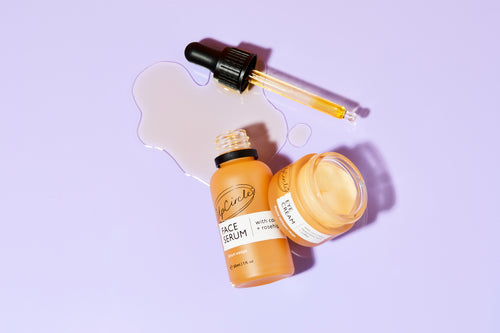

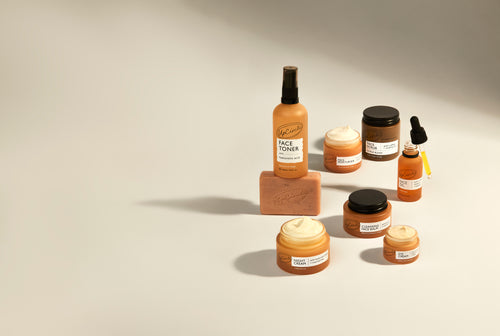
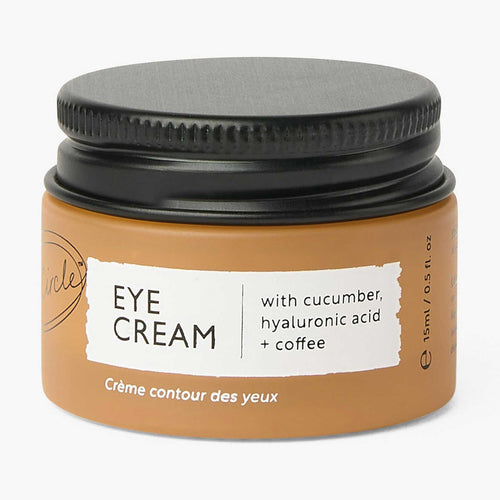


If you've come across maple bark on a skincare ingredient list and assumed it was a fragrance flourish, it isn't. Red maple bark extract is one of the most interesting plant antioxidants in modern formulation, and we use it as a headline active in our Eye Cream with Hyaluronic Acid + Coffee for reasons we can actually point at in the lab.
This piece is the long version. We'll cover where the bark comes from, what's in it that the skin cares about, what the published science does and doesn't say, and how to use it in a routine that actually delivers maple bark skincare benefits rather than wishful thinking.
Jump to: What is maple bark extract? | Where it comes from | The active compounds | What the science says | Maple bark vs other antioxidants | How to use it in your routine | UpCircle products with maple bark | Why rescued sourcing | FAQ
The short version: maple bark is rich in ellagic acid and a family of compounds called glucitol-core gallotannins. These polyphenols help the skin defend itself against the oxidative stress that comes from sunlight, screens and pollution, and they appear, in laboratory work, to slow the enzymes that break elastin down.
Key takeaways
- Maple bark extract (INCI: Acer Rubrum Extract) comes from red maple bark left over after maple syrup production in North America. The syrup industry has no use for the bark itself.
- Its main bioactives are ellagic acid (the same polyphenol found in pomegranate and raspberry) and glucitol-core gallotannins, both potent antioxidants. It also contains catechins, the family of polyphenols found in green tea.
- Published in vitro studies show maple bark extract inhibits elastase (the enzyme that degrades elastin), inhibits glycation (sugar damage to collagen and elastin), and absorbs a portion of high-energy visible light. Most research is on isolated extracts rather than finished cosmetic products.
- UpCircle uses maple bark as a headline active in our award-winning Eye Cream, where the under-eye area is most exposed to blue light from screens and earliest to show fine lines.
What is maple bark extract?
Maple bark extract is a standardised cosmetic active made from the inner bark of the red maple tree (Acer rubrum), concentrated for its polyphenol content. It is not the syrup, not the leaf, and not the wood. It is specifically the bark, the protective outer layer of the tree, processed into an extract that is high in antioxidant compounds and stable in formulation.
The botanical name matters because not every maple species is the same. Acer rubrum, the red maple, is the species the skincare-grade research is built on. It grows across eastern North America and is one of the species the maple syrup industry taps each spring.
1. The protective layer of the tree, applied to the protective layer of skin
We like the symmetry. Bark is the part of the tree that handles weather, UV, microbes and physical damage. It evolved to be antioxidant-rich because that's what protective tissue needs to be. When we read the ingredient list of our Eye Cream, we're applying a tree's defence chemistry to the most fragile section of human skin.
2. How it shows up on a label
On an INCI list, look for "Acer Rubrum (Maple) Extract" or "Acer Rubrum Bark Extract". If a product just says "maple extract" without the species, that's worth a question. The clinically interesting work has been done on Acer rubrum specifically, not on maple as a generic category.
Where the maple bark in our Eye Cream comes from
The maple bark we use is rescued from the supply chain of maple syrup production in North America. When a sugar maple or red maple is tapped for syrup, the bark itself isn't part of the saleable product. When trees are eventually felled or thinned, the bark has historically been a low-value by-product or waste stream. Our supplier extracts it for use as a cosmetic active, which means a part of the tree that would otherwise be discarded becomes a working ingredient.
This is the same logic we use across the rest of our range, from the coffee grounds rescued from London cafes in our scrubs to the argan shells in our Face Moisturiser with Vitamin E. We hear from customers that the rescued sourcing is a tiebreaker rather than the lead reason they buy. We agree with them, and we wrote about that worldview in our piece on how upcycled ingredients are chosen.
1. Why the by-product is the active
In any agricultural processing chain, the most concentrated parts of the plant are often the parts not eaten or drunk. Bark, peel, stone, husk and grind have to defend the rest of the plant, so they accumulate the antioxidant compounds. Diverting those streams into skincare isn't just a circular gesture, it's frequently the most efficient route to the active itself.
2. Named supply chain, not "natural origin"
"Natural origin" on a label means very little on its own. We try to be specific about the supplier, the country, and the by-product stream. For maple bark, that's North American syrup-industry by-product, processed into a standardised extract by a specialist supplier. If you're choosing between products and one says "natural maple extract" and the other names the source, the named-source version is the one to trust.
The active compounds: what's actually in maple bark
Maple bark extract is a polyphenol concentrate, which is to say it's a cocktail of plant antioxidant molecules rather than a single hero compound. Three families of molecule do most of the work.
1. Ellagic acid
Ellagic acid is a polyphenol antioxidant most people know from pomegranate and raspberry. It's a free-radical scavenger, which means it absorbs the unstable oxygen species generated by UV, visible light, and pollution before they can damage skin lipids and proteins. It also has demonstrated anti-glycation activity in lab models, meaning it interferes with the process by which sugar molecules cross-link to collagen and elastin and stiffen them. Glycation is one of the less-discussed drivers of skin ageing, and it's a useful angle for an ingredient to act on.
2. Glucitol-core gallotannins
This is the family of compounds that's specific to red maple bark, characterised in research published in the journal Phytochemistry. Gallotannins are large polyphenol molecules with multiple hydroxyl groups, which is the structural feature that gives them strong antioxidant activity. The "glucitol-core" version is unusually concentrated in Acer rubrum and is part of why this species, specifically, is the one cosmetic chemists reach for.
3. Catechins
Catechins are the green-tea polyphenol family, and maple bark contains them too. They're best characterised as antioxidants and have a long literature in skincare for supporting the skin's defence against UV-induced oxidative stress. They're a useful supporting cast around ellagic acid and the gallotannins.
4. Beta-hydroxy and small organic acids
Maple bark also contains small amounts of organic acids that contribute to its overall profile. These are not the headline actives, but they're part of why the extract behaves as a gentle skin-supportive ingredient rather than a stripping one.
What the science says, and what it doesn't
Most of the published research on maple bark extract is in vitro work on isolated extracts rather than clinical trials on finished cosmetic products. We're going to be straightforward about that, because the difference matters when you're deciding what to buy.
1. In vitro evidence: solid
Multiple peer-reviewed studies have shown that red maple bark extract inhibits elastase activity (the enzyme that breaks down elastin), inhibits tyrosinase activity (the enzyme involved in pigment formation), inhibits AGE formation (advanced glycation end-products, the sugar-damage cross-links), and acts as a free-radical scavenger. The published work on glucitol-core gallotannins from Acer rubrum describes the antioxidant chemistry in detail.
2. Blue-light protection: emerging
High-energy visible light, often called "blue light", is the wavelength range from screens, LEDs and a portion of daylight. It penetrates skin more deeply than UVB and contributes to oxidative stress and pigment changes. Maple bark extract has been shown in laboratory work to absorb a portion of this wavelength range, which is the basis for the blue-light protection claim. The evidence is from in vitro and ex vivo work, not large clinical trials, so we phrase it as "supports skin's defence against blue-light-induced oxidative stress" rather than "blocks blue light".
3. Anti-glycation: promising
Glycation is a slow process: dietary and metabolic sugars react with collagen and elastin to form rigid cross-links, and skin gradually loses elasticity as a result. Topical anti-glycation ingredients are an active research area. Maple bark's ellagic acid content gives it a credible mechanism here, but as with most anti-glycation actives, finished-product clinical evidence is still maturing.
4. What the science doesn't yet do
We can't yet point at a finished-product, double-blind, placebo-controlled trial that tests "maple-bark-containing eye cream vs identical formula without maple bark" over twelve weeks. That's the gold standard, and it doesn't exist for most natural cosmetic actives. Where we have isolated-extract evidence and a coherent mechanism, we use the ingredient and we say "supports". Where we don't, we don't claim. Our piece on common skincare myths goes into more detail on the difference between mechanism and finished-product evidence.
Maple bark vs other natural antioxidants
Maple bark isn't the only antioxidant in your routine, and it shouldn't be. The interesting question is what each natural antioxidant is best at, and how they layer. Here's how we think about the main four.
| Antioxidant | Primary mechanism | Strongest evidence | Best used for |
|---|---|---|---|
| Maple bark (ellagic acid + gallotannins) | Free-radical scavenging, elastase inhibition, anti-glycation, partial blue-light absorption | In vitro on isolated extracts; mechanism well-characterised | Under-eye area, blue-light defence, supporting skin elasticity over time |
| Vitamin C (L-ascorbic acid) | Free-radical scavenging, collagen synthesis cofactor, tyrosinase inhibition | Strong clinical evidence on finished products | Brightening, evening pigmentation, daytime antioxidant defence |
| Vitamin E (tocopherol) | Lipid-phase antioxidant, barrier support, regenerates vitamin C | Strong, especially in combination with vitamin C | Barrier support, dry-skin recovery, night-time repair |
| Niacinamide (vitamin B3) | NAD+ precursor, supports barrier, modulates pigment transfer | Strong clinical evidence at 4-5% | Pore appearance, redness, all-skin-types antioxidant support |
The honest read is: vitamin C and niacinamide have more finished-product clinical data than maple bark. Maple bark earns its place because it covers different mechanisms (specifically anti-glycation and elastase inhibition) and because it slots into the polyphenol category, which our skin can use alongside the vitamins rather than instead of them. Pairing matters as much as picking. We get into routine layering in our guide to hydrating ingredients for dry skin.
How to use maple bark in your routine
The honest answer is that you use it where it's been formulated to work, and you don't try to DIY a maple bark step. The active needs to be at the right concentration, in a base that lets it stay stable, and balanced with the rest of the formula. Here's where it earns a place.
1. Under the eyes, morning and night
The under-eye area is thinner and more reactive than the rest of the face, which makes it both the first place to show fine lines and the easiest place to see a difference when you support it well. It's also one of the most blue-light-exposed areas of skin if you spend hours looking at a screen, because that light hits eye-level skin head-on. Maple bark belongs here. Our Eye Cream with Hyaluronic Acid + Coffee uses it as a headline active alongside caffeine (for vasoconstriction and de-puffing) and hyaluronic acid (for hydration and plumping).
2. As an antioxidant layer, not a treatment step
Polyphenol antioxidants like maple bark are best thought of as supportive rather than corrective. You're not using them to fix something, you're using them to slow the rate at which environmental damage accumulates. That's why they belong in a daily-use product like an eye cream or moisturiser, applied consistently, rather than in an "intensive" once-a-week step.
3. Layered with vitamin C and niacinamide, not against them
Polyphenols, vitamin C and niacinamide play well together. A reasonable face routine layers them: a vitamin-C-containing serum or moisturiser in the morning, an eye cream with maple bark and caffeine, and a barrier-supporting moisturiser like our Face Moisturiser with Vitamin E on top. Our guide to choosing an eye cream for dark circles walks through how the eye-area layer fits the rest of the routine.
4. Patience over a six-to-twelve-week window
Antioxidants and elasticity-supporting ingredients work on the timescale of skin turnover, not overnight. The realistic expectation is firmer-looking under-eye skin and a brighter complexion over a six-to-twelve-week window of consistent use, not a forty-eight-hour transformation. We hear from customers that the eye cream is one of the products they notice most over a month or two, which fits the mechanism.
UpCircle products that contain maple bark
Maple bark earns its keep in formulas where the active fits the use case. We don't bolt it onto everything for the sake of marketing.
1. Eye Cream with Hyaluronic Acid + Coffee
This is the headline product for maple bark in our range. The Eye Cream is a 99% natural, vegan, dermatologically approved formula built around three actives: maple bark extract for antioxidant defence and elasticity support, caffeine from rescued coffee oil for de-puffing, and hyaluronic acid for hydration. It's our most-awarded product, suitable for all skin types including sensitive eyes, and dermatologically approved.
It's also one of the products customers most commonly buy on subscription. If consistency is the point, our Subscribe & Save programme takes the "did I order more in time?" question off your plate.
2. Face Moisturiser with Vitamin E + Aloe Vera
Our Face Moisturiser is the partner product to the eye cream in a daily routine. It's built on argan-shell powder rescued from the argan oil industry, rich in vitamin E for barrier support, and pairs neatly with the polyphenol antioxidants in the eye cream layer.
3. Mature Skin Bundle (Ageing Gracefully)
The Ageing Gracefully Skincare Bundle includes the Eye Cream alongside our Peptide Serum (clinically proven to improve elasticity by 29% in 14 days), Night Cream, Cleansing Face Milk and Face Moisturiser. If you're targeting elasticity and fine lines specifically, the bundle is the most efficient way to get the layered routine that the maple bark eye cream sits inside, and it ships at a 20% discount on the individual products.
Why rescued sourcing matters here, specifically
We try to lead with what an ingredient does for skin, then talk about where it comes from as the differentiator. With maple bark, the rescued story is genuinely an efficacy story too, not just a values one.
Bark is the part of the tree the syrup industry has historically had no commercial use for. Diverting it into a high-value cosmetic active does three things at once: it pays for the by-product stream, it reduces the volume of waste, and it gives our supplier the economic basis to invest in proper standardisation and quality control on the extract. A by-product that's used at scale becomes a reliable, well-characterised input, which is exactly what cosmetic chemistry needs.
It's also why we pair the rescued sourcing claim with the clinical and mechanistic evidence whenever we can. Rescued sourcing on its own is a values argument. Rescued sourcing plus mechanism is a values-and-efficacy argument, and the second one is the one we want to make. We've written more about this in our piece on natural vs organic skincare, which gets into where the meaningful distinctions actually live.
UpCircle is a certified B Corporation, which means our sourcing claims are independently audited rather than self-declared. As of 2026, we've rescued more than 400 tonnes of natural by-products into skincare formulas. The rescued maple bark supply chain is one of the streams that contributes to that number.
FAQ
What does maple bark do for skin?
Maple bark extract is a concentrated source of antioxidant polyphenols, including ellagic acid and glucitol-core gallotannins. It supports the skin's antioxidant defence against environmental stressors, helps protect against blue-light-induced oxidative stress, and has been shown in laboratory work to inhibit elastase (the enzyme that breaks down elastin) and the formation of advanced glycation end-products.
Is maple bark good for under-eye skin?
Yes, and that's the use case our Eye Cream is built on. The under-eye area is thinner, more reactive, and more blue-light-exposed than the rest of the face, which makes it the area where antioxidant support and elastin protection have the most visible payoff over time.
Is maple bark safe for sensitive skin?
Maple bark extract is well tolerated by most skin types, including sensitive skin, when formulated correctly. Our Eye Cream is dermatologically approved and safe for sensitive eyes. As with any new product, patch test on the inside of the wrist for 24 hours if you have a history of reactivity. Our guide to signs of a damaged skin barrier has more on what to do if your skin is currently in a reactive phase.
How long does it take to see results from maple bark skincare?
Realistically, six to twelve weeks of consistent daily use. Polyphenol antioxidants and elasticity-supporting ingredients work on the timescale of skin turnover, not overnight. You may notice brightness and reduced under-eye fatigue earlier (the caffeine in our Eye Cream contributes there), but the maple-bark-specific benefits compound with consistency.
Is maple bark the same as maple syrup in skincare?
No. Maple syrup is the sap, processed into sugar; maple bark extract is from the bark itself, processed for its polyphenol content. They're chemically very different. Some skincare products use maple syrup or sugar for humectant or exfoliant purposes, which is a separate use case from maple bark's antioxidant role.
Is maple bark vegan and cruelty-free?
Yes. Maple bark is a plant-derived ingredient, and our Eye Cream is 100% vegan, cruelty-free and dermatologically approved. The bark is sourced as a by-product of maple syrup production, so its use in skincare doesn't drive incremental tree harvesting.
Can I use maple bark extract with retinol or vitamin C?
Yes, polyphenol antioxidants like the ellagic acid in maple bark layer comfortably with both vitamin C and gentle retinol alternatives. If you're new to active layering, a sensible default is vitamin C in the morning, an antioxidant eye cream, and a retinol or retinol-alternative at night. Our guide to uneven skin tone and texture covers how to sequence those steps without overloading the skin.
Where does UpCircle's maple bark come from?
Our maple bark extract is sourced from red maple (Acer rubrum) bark, rescued as a by-product of the maple syrup industry in North America. The bark is processed into a standardised cosmetic active by a specialist supplier. We pair the rescued sourcing claim with the underlying ingredient science, because we think both halves of the story matter. Find out more on our about page.
Why this comes from us
UpCircle is a certified B Corporation founded in 2016, dermatologically tested across the range, and clinically tested on hero products including the Peptide Serum (29% improvement in skin elasticity in 14 days, third-party-lab verified). We've rescued over 400 tonnes of natural by-products into skincare to date, working with named suppliers and named by-product streams rather than generic "natural origin" claims.
Maple bark is one of the ingredients we're proudest of. It hits all four of our pillars: rescued source, named supply chain, real bioactives backed by published mechanistic research, and a clear use case in a finished product that customers actually re-order. If you'd like a personalised recommendation for which of our products fits your skin, the skin quiz takes about two minutes.
Where to start
If maple bark is new to your routine, the most direct entry point is our Eye Cream with Hyaluronic Acid + Coffee. It's our flagship maple-bark product and the one with the most evidence-led pairing of actives.
If you're building out a fuller routine for elasticity and fine lines, the Ageing Gracefully Skincare Bundle brings the eye cream together with our peptide serum and night cream at a 20% saving, which is the most efficient way to give the polyphenol antioxidants the routine context they work best inside.
And if you want to keep your routine consistent without thinking about it, Subscribe & Save means your eye cream arrives on cadence and you save on every recurring order. Consistency is most of the battle with antioxidants. The product we never run out of is the one that does the most for our skin.