







Jump to: What circular beauty actually means · Circular beauty vs clean, natural, sustainable, eco-friendly · The four pillars of circular beauty · What circular beauty is not · How to spot a genuinely circular brand · Real examples from our own supply chain · Where to start with circular beauty · Why the difference matters for skin and waste · FAQ
If you have spent more than five minutes in the beauty aisle in the last few years, you have probably noticed that almost every brand on the shelf now describes itself as clean, natural, sustainable, eco-friendly, or green. Most of those words mean almost nothing. Circular beauty is one of the few terms in this corner of the industry with a real, testable definition behind it, and it is worth understanding because it tells you something specific about where the ingredients in your jar came from and what happens to the packaging once it is empty.
This is the definitive guide we wished existed when we started UpCircle in 2016. We will cover what circular beauty actually is, how it differs from the vaguer language around it, the four pillars that make a product genuinely circular, and how to tell a brand doing the work from a brand using the word as decoration. Where it helps, we will use real examples from our own supply chain, including the coffee we rescue from London cafes and the apricot stones we use in our Cleansing Face Balm.
Key takeaways
- Circular beauty is the design principle of using ingredients that already exist as by-products of other industries, in packaging that can re-enter the recycling stream, with the explicit goal of eliminating single-use waste from the formula and the bottle. It is the only one of the popular sustainability terms with a working definition.
- The four pillars are: rescued or upcycled ingredients, recyclable packaging, reduced single-use plastic across the full product, and traceable transparent sourcing.
- Circular beauty is not the same as clean, natural, sustainable, or eco-friendly. Those terms are mostly unregulated and tell you nothing about where the ingredient came from or where the packaging is going.
- UpCircle has rescued over 450 tonnes of would-be waste since 2016, including coffee grounds from London cafes, argan shells from argan oil production in Morocco, apricot stones from the apricot oil industry, maple bark from furniture production, and chai spices from a family owned chai company based in Bath in the UK.
What circular beauty actually means
Circular beauty is the application of circular-economy principles to skincare, haircare and body care. It means designing products that use ingredients that already exist as by-products of another industry, in packaging that can re-enter the recycling stream, with the deliberate goal of removing single-use waste from both the formula and the bottle. The term is borrowed from the broader circular-economy framework defined by the European Commission, which contrasts a "take, make, dispose" linear model with one where materials are kept in use for as long as possible.
In practical terms, that means a circular beauty brand has to be able to answer two questions about every product. Where did the ingredients come from before they were ingredients, and where will the packaging go after it is empty. If a brand cannot answer either question with specifics, the word "circular" is doing decorative work. Our take is that the only honest version of circular is one you can trace, and that is the bar we hold ourselves to. It is also why we cite our suppliers by name on the page rather than in a sustainability report no one reads.
Circular beauty is often confused with related terms. The next section walks through how it differs from the labels you will see on the same shelf, and why most of those labels are far less specific than they sound.
Circular beauty vs clean, natural, sustainable, eco-friendly
The reason circular beauty is worth understanding as a separate category is that the language around sustainable skincare has become so diluted that most of it is not informative. A "clean" product can still come in single-use plastic from virgin oil. A "natural" cream can still be packaged in five layers of mixed materials no recycler can process. The label tells you almost nothing about the supply chain. Circular beauty, by contrast, makes a specific claim about where the ingredients came from and where the packaging is going. The table below sums up the difference.
| Term | What it claims | What it actually tells you | Regulated? |
|---|---|---|---|
| Circular beauty | Ingredients are by-products of another industry, packaging can re-enter the recycling stream | Specific source and end-of-life path for both formula and packaging | Self-defined, testable against the four pillars below |
| Clean beauty | Free from a list of ingredients the brand considers harmful | The brand's own avoid-list, which varies wildly | No legal definition |
| Natural | Ingredients are plant or mineral-derived | Almost nothing about source, ethics or end-of-life | No legal definition in the UK or EU |
| Sustainable | Practices reduce environmental harm over time | Whatever the brand wants it to mean unless certified | Only meaningful when paired with B Corp, Soil Association, or similar |
| Eco-friendly | Less harmful to the environment than the alternative | Vague comparative claim with no reference point | No legal definition; flagged in green-claims guidance |
| Green | Environmentally positive | Marketing colour | No legal definition |
This is not a counsel of despair. Some brands using "natural" or "clean" are doing serious work, and certifications like B Corp and Soil Association add real teeth to the looser terms. But on its own, no word in that table tells you what circular beauty does, which is exactly where the ingredient came from and exactly where the bottle is going. If you want a complementary read on this distinction, our piece on natural vs organic skincare covers the certified-vs-vague split in more detail.
The four pillars of circular beauty
A genuinely circular product clears all four of the following bars. Anything weaker is partial circularity at best, and anything that fails on rescued ingredients is borrowing the word for marketing.
1. Rescued or upcycled ingredients
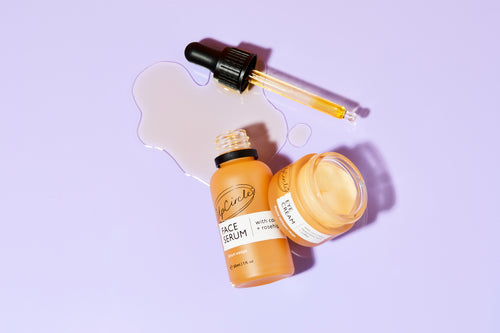
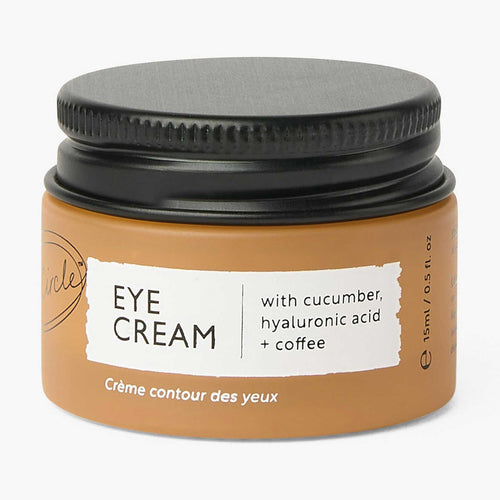
The formula is built around materials that already exist as by-products of another industry. The classic example, and the one we built UpCircle on, is spent coffee grounds rescued from London cafes. The grounds are full of caffeine and antioxidant chlorogenic acid that the cafe's espresso machine extracts only a small fraction of, and a vasoconstricting active that would otherwise be sent to landfill becomes the working ingredient in our Eye Cream, Face Scrub and Body Scrub. We have written more about how this works in our product developer's view on choosing upcycled ingredients.
2. Recyclable or returnable packaging
The container, lid, and pump are designed to re-enter the recycling stream rather than the bin. Glass jars, aluminium lids, and PCR (post-consumer recycled) plastic where glass is not practical are the standard. Mixed-material packaging, soft pouches, and sachets that cannot be recycled in domestic kerbside streams undermine everything the formula claims to do.
3. Reduced single-use across the full product
Single-use plastic is removed wherever a sensible alternative exists. That includes the bottle, the cap, the seal, the box, and the dispenser. A formula made from rescued ingredients in a single-use plastic shrink-wrapped pump is not circular. The full lifecycle has to be designed for re-entry into a circular flow, not a partial wash with one ingredient doing the marketing work.
4. Transparent, traceable sourcing
The brand can name the supplier of each rescued ingredient by industry, region, or partner. "We use upcycled coffee" is the floor. "Spent grounds from independent London cafes, collected daily and processed within 48 hours" is what circular looks like when it is being done seriously. If a brand cannot tell you where the rescued ingredient came from, the rescued claim is doing decorative work.
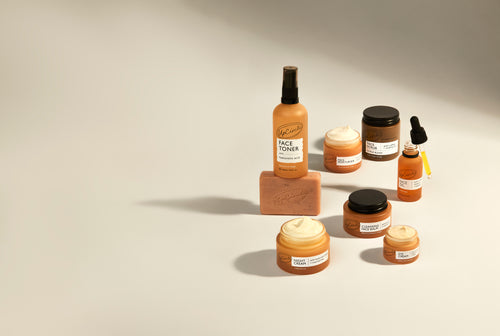
To see how the pillars combine in a working routine, our face-care collection is built so that every product in the range clears all four bars. The same is true of body care.
What circular beauty is not
The honest version of this article has to spell out what we mean by partial circularity and what we mean by greenwashing. The line between them is genuine effort plus traceable specifics.
1. It is not the same as plant-based
Plant-based means an ingredient is derived from a plant. It says nothing about where the plant was grown, what was done with the by-products, or whether anything was rescued. Palm oil is plant-based. Conventional cotton is plant-based. Plant-based without context is not circular.
2. It is not the same as recyclable packaging on a virgin formula
A virgin coconut oil moisturiser in a glass jar is recyclable, but the formula is still made of newly extracted ingredients from primary supply chains. The packaging is doing one pillar of the work. The other three pillars are still missing. Half-circular is more accurate, and it is worth saying out loud.
3. It is not the same as carbon-neutral
Carbon offsets buy emissions reductions elsewhere. They do not change what is in the bottle. A brand can be carbon-neutral and still send extractive single-use waste through its products every day. The two claims are not interchangeable, and a circular brand should be doing both. We track our footprint independently from our circular sourcing for exactly this reason.
4. It is not greenwashing
The UK Competition and Markets Authority published its Green Claims Code in 2021 in response to the volume of vague environmental claims on supermarket shelves. Its core test is whether a claim is truthful, clear, unambiguous, and supported by evidence. Most "eco" claims do not pass. Circular beauty is meant to clear that bar by being specific enough to verify.
How to spot a genuinely circular brand
If you want a quick test you can run in the aisle or on a brand's website, here is what we look for ourselves. The same checklist underlies our own about page.
1. Named suppliers, not vague provenance
"Upcycled coffee" with no further detail is a marketing line. "Spent Arabica coffee grounds collected from named independent London cafes" is a supply chain. Look for industry, region, or named partners. The more specific the claim, the more verifiable.
2. Volumes, not vibes
Numbers are the cheapest form of accountability. We say UpCircle has rescued over 450 tonnes of would-be waste coffee grounds since 2016 because we can show the weight slips. A brand that cannot quantify what it has rescued probably has not rescued much. Vague volume claims fail the Green Claims Code test for the same reason.
3. End-of-life answers
What happens to the packaging after the product is finished. If the brand cannot tell you which parts go in which kerbside stream, the recyclable claim has not been thought through. Glass jar, aluminium lid, paper outer, kerbside-recyclable in the UK is the standard answer. A Subscribe & Save loop on top is bonus credit, not a fig leaf for an unrecyclable bottle.
4. Independent certifications
B Corp certification audits a brand on environmental and social impact, with a public scorecard. Our own B Corp profile is on the public directory. Soil Association, Cruelty-Free International's Leaping Bunny, and the Vegan Society are similarly third-party verified. They are not a complete substitute for circular sourcing, but they are a strong signal that the brand has shown its working to someone other than its own marketing team.
5. The website explains what is and is not circular
An honest brand will tell you which parts of its range are most circular and which ones are still being improved. A brand that claims everything is fully circular is almost certainly hiding the partial answers. We talk openly about which formats are easier to make circular than others on our myth-debunking blog.
Real examples from our own supply chain
The fastest way to make circular beauty concrete is to walk through what it looks like inside an actual product range. Five examples from ours, each tied to a specific industry and a specific by-product.
1. Coffee grounds from London cafes
The original UpCircle ingredient. We collect spent coffee grounds from independent cafes around London, process them, and use them as the active in our Eye Cream with Hyaluronic Acid, our Coffee Face Scrub and our Coffee Body Scrub. Caffeine is a vasoconstrictor that narrows small blood vessels and reduces fluid pooling, which is why topical caffeine has measurable effects on the skin's microcirculation. Sustainability is the by-product here, not the lead. The grounds are a brilliant active first.
2. Argan shells from argan oil production in Morocco
Argan shells are normally a waste stream of the argan oil industry. We use them in our Face Moisturiser with Vitamin E because they're rich in omega fatty acids, as well as being able to help regulate sebum production. Argan stone powder is finer than walnut shells, which means they won't cause micro-tearing on the skin barrier. The oil-pressing process we are downstream of would otherwise discard the shells as agricultural by-product.
3. Apricot stones from the apricot oil industry
Our Cleansing Face Balm is built around finely-ground powder from discarded apricot stones, a natural by-product of the apricot oil industry. Apricot powder is naturally rich in antioxidant Vitamin E, which nourishes the skin barrier and helps protect skin from free radical damage. The balm won the CEW Responsibility Award in 2022 for the supply chain behind it as much as the formula.
4. Maple bark from furniture production
Maple bark is a by-product of the furniture industry. It is naturally rich in polyphenols and beta-hydroxy acids that support skin renewal. We use a maple bark extract in our Eye Cream alongside the coffee, which is one of the reasons that single product clears the four-pillars test on more than one rescued ingredient. We have written more about this in our eye-cream-for-dark-circles guide.
5. Chai spices from a Bath chai company
Cardamom, cinnamon, ginger, and cloves left over from chai production are reformulated as antioxidant-rich actives in our organic cleansing bars. Cinnamon supports microcirculation, cardamom and cloves contain anti-inflammatory compounds, and the organic spent spices were already aromatic. The local sourcing keeps the supply chain short, which is a quieter circular benefit that does not always make the product page.
Where to start with circular beauty
If you want to try circular beauty without overhauling your whole routine, the easiest entry point is one product where the rescued ingredient is doing the active work. Three sensible places to start.
1. The Eye Cream, if dark circles or puffiness are your concern
Our Eye Cream with Hyaluronic Acid + Coffee uses caffeine from rescued coffee grounds and maple bark extract from syrup production, paired with hyaluronic acid for plumping. It clears all four pillars in one product.
2. The Cleansing Face Balm, if you wear makeup or live in a city
The Cleansing Face Balm uses apricot powder from the apricot oil industry, in a glass jar with an aluminium lid. It is a clean lift-off cleanser that doubles as a makeup remover, and it is the easiest single-product swap if your existing cleanser comes in mixed-material packaging.
3. Subscribe & Save, if you want to lock circular into your routine
Our Subscribe & Save programme is the way we make circular shopping cheaper than the linear alternative. It is the closest thing we have to a low-friction commitment, and it is the right avenue for circular-curious customers who do not want to think about reordering. If you are not sure where to start, our skin quiz is a four-minute path to a sensible first product.
Why the difference matters for skin and waste
It would be possible to read all of the above as semantic. It is not. The reason the distinction between circular beauty and the looser terms matters is that the looser terms have not produced measurable improvements in waste outcomes for the beauty industry, and circular sourcing has. The beauty industry produces around 120 billion units of plastic packaging a year, and the recycling rate sits below 10 per cent. Most of the brands using "clean" or "natural" or "eco" on their packaging are still part of that statistic. Circular beauty is small as a category, but the brands clearing the four-pillars test are the ones whose growth does not depend on adding new extraction to the supply chain.
For your skin specifically, the difference is more subtle but still real. Rescued ingredients tend to be processed more gently than virgin ones, because the supply chain is upstream of waste rather than upstream of profit. The coffee oil we use in our Face Scrub is extracted at low temperatures from grounds that already had their first extraction at the cafe. The apricot powder in our Cleansing Face Balm is the same fine grind the apricot-oil industry was already producing. You are getting the active part of the ingredient, often with more antioxidant content intact, because nothing has been refined out of it for shelf life or aesthetic reasons.
The short version. Circular beauty is one of the few sustainability terms that survives the Green Claims Code test. It is built on a definable set of pillars. It produces real, measurable reductions in supply-chain waste, and it tends to give you ingredients that are still chemically interesting. Everything else on the shelf is borrowing the language without doing the work.
Frequently asked questions
What is circular beauty in simple terms?
Circular beauty is skincare and body care that uses ingredients which are by-products of another industry, in packaging designed to re-enter the recycling stream, with the deliberate goal of removing single-use waste. Coffee grounds rescued from cafes and apricot stones rescued from the oil industry are two real examples.
Is circular beauty the same as clean beauty?
No. Clean beauty refers to a brand's own avoid-list of ingredients it considers harmful, which varies between brands and has no legal definition. Circular beauty is about the source of the ingredients and the end-of-life of the packaging. A product can be one without being the other.
How is circular beauty different from sustainable beauty?
"Sustainable" is a broad, mostly unregulated term that any brand can apply to itself. Circular beauty is a specific subset of sustainability, focused on rescued ingredients and packaging that can re-enter the recycling stream. If a brand says circular, ask which by-products and which packaging streams. If a brand says sustainable, ask whether it is certified by anyone outside its own marketing team.
Are upcycled ingredients actually effective for skin?
Yes, and often more so than virgin alternatives. Spent coffee grounds still contain most of the caffeine and chlorogenic acid the espresso machine did not extract, and apricot stones are a finer, gentler exfoliant than many virgin alternatives. The cafe or the oil press did the first round of processing for free, and the actives we are interested in survive that.
What does B Corp certification have to do with circular beauty?
B Corp is third-party certification of a company's environmental and social practices, audited against a public scorecard. It is not the same as circular beauty, but it is a strong signal that the brand has shown its working to someone independent. UpCircle is B Corp certified and has been since 2020.
How can I tell if a brand is doing circular beauty properly?
Look for named suppliers and named industries for each rescued ingredient, specific volumes of waste rescued, clear end-of-life instructions for the packaging, and at least one independent certification like B Corp or Soil Association. If any of those four are missing, treat the circular claim as marketing language until proven otherwise.
What is the easiest way to make my routine more circular?
Pick one product where the rescued ingredient is doing the active work and swap your existing version for it. Our Subscribe & Save programme on the chosen product keeps the same kerbside-recyclable glass-and-aluminium packaging on autopilot and locks in a discount, which makes a circular routine cheaper than buying ad hoc.
About UpCircle. We have been making circular beauty since 2016 and have rescued over 450 tonnes of would-be waste coffee ALONE in that time - plus over 50 additional upcycled ingredients. Our products are clinically tested, made in the UK, vegan and cruelty-free, and we have been B Corp certified since 2020. Every product on our site is built around a rescued ingredient sourced from a named industry, in glass-and-aluminium packaging designed for kerbside recycling. If you want to take the four-pillars test on your own bathroom shelf, it starts at our face-care collection and our Eye Cream.
Not sure where to start? Our four-minute skin quiz matches you to a sensible first product, our product developer's view on choosing upcycled ingredients goes deeper on the sourcing decisions, and our Subscribe & Save programme is the way we make a circular routine cheaper than buying single bottles.