





A moisturiser is sustainable when you can trace three things: what the pack is made of and what happens to it after you finish, where the ingredients came from, and which words on the label are backed by an independent standard rather than a marketing team. Almost nothing on the front of a jar tells you all three. This guide gives you a framework you can apply to any moisturiser on any shelf in the UK, including ours.
Key takeaways
- Sustainability in a moisturiser is four separate questions, not one: the packaging, the formulation, the certification and whether the pot gets finished. A product can score well on one and poorly on the other three.
- "Natural" is not a regulated term in UK cosmetics and proves very little on its own. "Organic" only carries weight when a named standard such as COSMOS sits behind it.
- "Cruelty free" is a weak differentiator in the UK, because animal testing for cosmetic products is already prohibited under the Cosmetics Regulation. Independent certification such as Leaping Bunny is what adds information.
- Vegan and cruelty free are two different claims, certified by different schemes. The Vegan Society's Vegan Trademark is assessed product by product.
- Any environmental claim made to UK shoppers has to comply with consumer protection law, and the Competition and Markets Authority's Green Claims Code sets out how. A vague claim with no evidence behind it is a warning sign, not a selling point.
What makes a moisturiser sustainable? The short answer
A moisturiser is sustainable to the degree that its packaging can realistically be recycled where you live, its ingredients are sourced in a way the brand will describe in detail, its claims are verified independently, and the product is one you will finish. Those four tests are independent of each other. A glass jar full of a formula the brand will not discuss is not a sustainable product. Neither is a well sourced formula in a pack your council will not take.
This matters more for moisturiser than most categories because of volume. A face cream is used twice a day for years, so small differences in how a 60ml pot is made and disposed of repeat hundreds of times over a lifetime of buying.
Test one: start with the packaging, because it is the part you throw away
Packaging is the easiest part of a moisturiser to assess honestly, because you can hold it: the formula gets used, the pack is what is left.
One thing never printed on a label is worth knowing: larger UK businesses have legal duties around the packaging they place on the market, including reporting and paying towards its collection and recycling, set out in the government's guidance on packaging producer responsibilities. The national picture on what actually gets collected sits in the government's waste and recycling statistics.
Which materials your council will actually collect
The most useful question is not "is this recyclable?" but "will my council collect this?" Only the second determines what happens to the pack. Kerbside collections differ by local authority, which is why a pack marked recyclable in one town goes to general waste in the next, so the reliable check is your council's list via the gov.uk recycling collections service.
As a rule of thumb, single-material components score better than mixed ones. A glass jar with a metal lid is two clean, separable materials. A plastic pump dispenser is usually several materials bonded together, including a metal spring, which is far harder to separate at a sorting facility. If a pack cannot be pulled apart, assume it is judged by its most difficult component.
The packaging to product ratio
The second question is how much pack you buy per millilitre of cream. A rigid carton around a jar inside a shrink sleeve is three layers for one product. A larger size almost always carries less packaging per use than several small ones, which is the honest argument for buying a bigger pot of something you already like. Our jumbo Face Moisturiser exists for that reason, and the same logic applies to any brand's larger format.
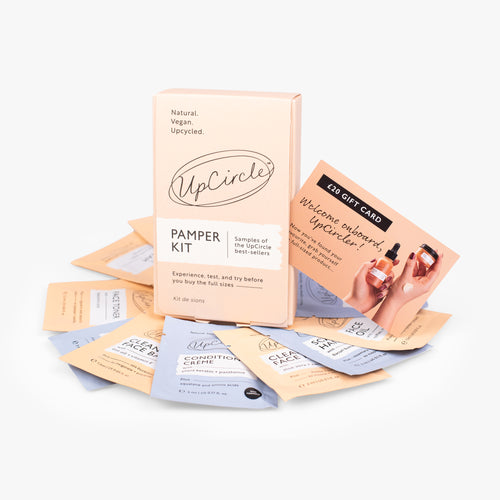
The counterweight is trial. A full-size pot that turns out not to suit you is worse on every measure, so sachets and travel sizes, like our 3ml moisturiser sachet or the travel size, earn their packaging when they prevent a full-size mistake.
Test two: read the formulation, not the front of the jar
The formula is where most of a moisturiser's footprint sits, and where the least information is usually offered. The front of a jar is marketing. The back is regulated. The ingredients list is the only part of the label that has to tell you what is in the product, and it is ordered by concentration. Our guide to reading a cosmetics ingredients list explains how to decode one.
Where the ingredients came from
Sourcing is the question a genuinely sustainable brand answers in detail and a green-sounding one answers in adjectives. Ask where a headline ingredient comes from and look for a specific answer: a named crop, region or by-product stream. Ingredients recovered from other industries' surplus are one of the stronger sourcing stories, because the material already exists and needs no new land or water to grow. We covered the evidence in are upcycled ingredients effective and the wider model in what is circular beauty. Be equally willing to accept a good conventional answer: a responsibly farmed, certified crop with a transparent supply chain is a strong result. The failure mode is not conventional sourcing, it is silence.
The "natural" trap
"Natural" is not a protected or regulated term in UK cosmetics, which means any brand can print it. It says nothing about how an ingredient was farmed, how far it travelled, or how much plant was consumed per gram extracted. Some natural-origin ingredients carry heavy land and water footprints. The word tells you a story, not a score, and we unpicked the differences in natural vs organic. The same caution applies to free-from lists, which tell you what is absent, never what is present.
Test three: certifications, and what each one actually proves
Certification converts a brand's word into somebody else's verification. Each label proves a narrow, specific thing, and the mistake shoppers make is assuming they overlap. Our explainer on decoding eco-certifications covers the badges you will meet.
Organic and natural: COSMOS
COSMOS is the international standard behind the COSMOS ORGANIC and COSMOS NATURAL signatures, defining criteria a company must meet for a product to be sold as genuinely organic or natural cosmetics, with separate designations for raw materials. The practical point is simple: an organic claim with COSMOS behind it has been assessed against a published standard, and an organic claim with nothing behind it has not.
Vegan and cruelty free: two different questions
Vegan means no animal-derived ingredients. Cruelty free means no animal testing. A product can be one without the other, which is why they are certified separately. The Vegan Society's Vegan Trademark is assessed application by application by its own team, making it a stronger signal than an unverified "vegan" on a carton. We covered the ingredient side in what makes skincare vegan.
On cruelty free, UK shoppers should know the baseline. Cosmetic products sold here fall under the Cosmetics Regulation, whose Article 18 covers animal testing, enforced domestically through the Cosmetic Products Enforcement Regulations 2013. Because the prohibition already applies, "not tested on animals" on a UK moisturiser is closer to a legal baseline than a distinguishing feature. What adds information is independent certification such as Leaping Bunny, which sets requirements across a brand's suppliers rather than the finished product alone.
Company-level certification
Product certifications say nothing about how the company behind the product operates. Company-level certification such as B Corp assesses the business rather than the formula. It is no substitute for the product tests above, and a certified company can still sell a badly packaged moisturiser, so treat it as a separate data point. You can read how we were assessed on our B Corp page.
The comparison table: what each signal proves, and what it does not
| Signal on the pack | What it genuinely tells you | What it does not tell you | How much weight to give it |
|---|---|---|---|
| "Natural" | Very little. Unregulated in UK cosmetics. | Farming method, footprint, transport. | Low on its own. |
| "Organic" with COSMOS | The product met a published organic or natural standard. | Anything about packaging or the company. | High, for the formula. |
| Vegan Trademark | No animal-derived ingredients, assessed by The Vegan Society. | Whether it was animal tested, or how it is packed. | High, for that one question. |
| Leaping Bunny | Independent cruelty free certification reaching into suppliers. | Sourcing footprint or packaging. | Medium to high in the UK, where a ban already applies. |
| "Recyclable" | The material can be recycled somewhere. | Whether your council collects it. | Low until you check locally. |
| Glass, aluminium or single-material packs | Separable materials sorting facilities handle more easily. | Weight, transport emissions, what is inside. | Medium to high. |
| B Corp | The company was assessed against a business standard. | Whether this product is well made or well packed. | Medium, at company level. |
Read the table as a scorecard, not a hierarchy. A moisturiser collecting three medium signals across different rows is usually a better bet than one with a single strong badge and nothing else to say.
How UK law frames a green claim, and how to use that
Environmental claims made to UK shoppers sit under consumer protection law, and the Competition and Markets Authority publishes the Green Claims Code to help businesses understand and meet those obligations. You do not need to read the guidance to benefit from it. You just need to borrow its instinct: a claim should be specific, capable of being substantiated, and clear about which part of the product or business it applies to.
So when a moisturiser says "sustainable", ask which part. "Better for the planet", ask than what. "Recyclable", ask which component. A brand that has done the work has an answer ready, usually on a dedicated page rather than the pack: ours sits on our packaging page and our ingredients page. A brand that has not will change the subject.
Test four: the factor almost nobody scores
The least sustainable moisturiser is the one you do not finish. A half-used pot at the back of a cupboard has consumed all of its packaging, ingredients and transport, and delivered a fraction of its use. No certification recovers that.
This makes suitability an environmental question, not just a skin one. A moisturiser that suits your skin type and the texture you like gets used to the bottom. One that does not, does not. It also makes the case for buying fewer, better-matched products, and for the unglamorous business of emptying the pot: we wrote a guide on getting every last drop out of a product, and a pair of cosmetic spatulas gets more out of a jar than fingers do. If you are unsure whether you need a richer or lighter formula in the first place, start with our explainer on hydration versus moisturisation, because matching the product to the need is what makes it get finished.
Running the framework on a real product, including ours
A framework is only useful if it can produce an unflattering result, so here it is run on our Face Moisturiser with Vitamin E, gaps left in.
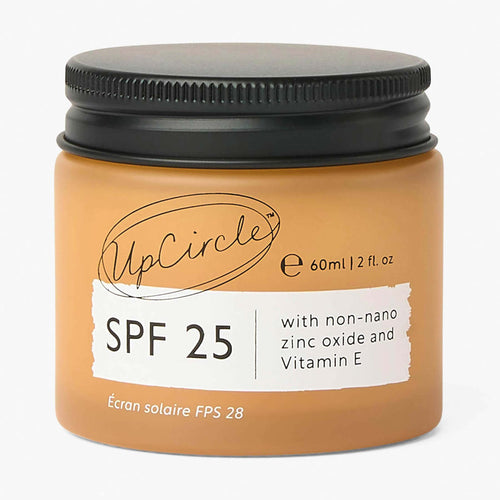
Packaging. A glass jar with an aluminium lid: two separable materials rather than a bonded assembly. Whether your council collects both is still a local question, so check the list. Formulation. It is made with the finely ground powder of surplus argan shells, a by-product of the argan oil industry, alongside cocoa butter, aloe vera and blood orange. That is a specific sourcing answer rather than an adjective, which is the bar we are asking other brands to clear too. Certification. Vegan, cruelty free, and made in the UK by a certified B Corp. Finishing it. A single cream for all skin types rather than a multi-step system, which is the format most likely to get used up.
Where it does not score: it is a jar rather than a single-material pack, and glass carries a real weight penalty in transport compared with a tube. Those are genuine trade-offs, and any brand telling you their packaging has no downside is skipping a column of the table. The same framework points at different answers elsewhere in a routine: a night cream, an organic face oil, a cleansing face milk, a hand and body lotion and a body cream sit in different pack formats for different reasons, and each deserves the same four questions.
The two-minute version, for use in a shop
Turn the pack over and ask four questions. One: what are the components made of, and can I separate them? Two: does the ingredients list, or the brand's website, name where the headline ingredient came from? Three: is there a named certification, and do I know what it covers? Four: honestly, will I finish this?
Three good answers out of four is a strong result. One badge and three shrugs, put it back. And if a product's whole sustainability case is a single word in a green font, treat that as the absence of a case rather than the presence of one. Our plastic-free skincare routine guide applies the same thinking across a shelf, and our buyer's guide to spotting a circular brand takes it to company level.
Frequently asked questions
What makes a moisturiser sustainable?
Four things, judged separately: packaging you can realistically recycle where you live, ingredients with a specific traceable sourcing story, claims verified by an independent standard rather than asserted by the brand, and a formula suited enough that you finish the pot.
Is a natural moisturiser better for the environment?
Not automatically. "Natural" is not a regulated term in UK cosmetics, so it carries no verified environmental meaning on its own, and some natural-origin ingredients have significant land and water footprints. Judge the sourcing and the certification, not the word.
What is the most sustainable moisturiser packaging?
The one your local authority collects, made of the fewest separable materials, carrying the least pack per millilitre. Glass and aluminium are simple and separable but heavier to transport. There is no single winner, which is why checking your council's list comes first.
Is a vegan moisturiser the same as a cruelty free one?
No. Vegan concerns ingredients, cruelty free concerns testing, and they are certified by different schemes: the Vegan Society's Vegan Trademark covers the first, Leaping Bunny the second. A product can hold one and not the other.
How can I tell if a moisturiser is genuinely cruelty free in the UK?
Start from the baseline that animal testing for cosmetic products is prohibited under the Cosmetics Regulation that applies here, so the phrase alone adds little. What adds information is independent certification such as Leaping Bunny, which sets requirements across a brand's suppliers, not just the finished product.
Are plastic-free moisturisers actually plastic free?
Sometimes, and sometimes only the outer pack is. Check every component: lid liner, seal, label and outer wrap. If a brand cannot itemise the pack for you, treat the claim as unverified. See how we describe ours on our packaging page and in our plastic-free collection.
Why you can trust this guide
UpCircle is a certified B Corporation making skincare from surplus and by-product ingredients, starting with coffee grounds collected from London cafes. We sit inside this category rather than outside it, and it is worth stating plainly that we have a commercial interest in you buying a moisturiser. That is exactly why this guide is built so you can run it against us. Every environmental claim above is either a description of a material or tied to a named source you can open: government guidance on green claims and packaging, the COSMOS standard, The Vegan Society, Leaping Bunny and the Cosmetics Regulation. Where our product has a trade-off, we wrote it down. If a brand will not do that, including us, that is your answer.
Where to go next
Read more. For the concept behind all of this, start with what is circular beauty, then decoding eco-certifications for the badges.
Explore the range. Browse our vegan and plastic-free moisturisers and run the four questions on each before you buy.
Shop the hero. If the framework leads you here, our Face Moisturiser with Vitamin E is a single cream for all skin types, made in the UK with the ground powder of surplus argan shells, in a glass jar with an aluminium lid. Trade-offs and all.