





The plastic-free bathroom swaps that actually last are the ones that replace something you already buy on repeat, without asking you to change how you do it. A metal safety razor, bamboo cotton buds, washable pads and cloths, and a solid cleansing bar all clear that bar. Most swaps that fail are not badly made. They fail because they added a step, and the step did not survive a busy Tuesday.
This is an honest sort: which swaps genuinely last, which are over-sold, and how to tell in advance. A swap that sits unused in a drawer is not a saving. It is a different object you bought.
Key takeaways
- The swaps that last are like-for-like: same action, same place in your routine, no extra steps.
- A safety razor is the highest-leverage swap in most bathrooms: the handle is permanent, and only a thin steel blade is consumed.
- Bamboo cotton buds are the easiest swap of all, and England has banned the supply of plastic-stemmed buds since 1 October 2020.
- Washable pads and cloths last for years, but only if you already do laundry regularly.
- Check what your council collects before buying anything labelled compostable, and never bulk-buy an untested swap.
- The honest test is not "is this plastic-free?" It is "will I still be using this in two years?"
What counts as a plastic-free bathroom swap?
A plastic-free bathroom swap is a long-life object that replaces a disposable plastic one you would otherwise keep re-buying. That rules out a lot of what gets sold under the same heading, because swapping one single-use item for a slightly better single-use item is a smaller change than it looks.
There are three honest categories: durable tools bought once and kept, format changes that cut packaging by cutting water, and material substitutions that change what an item is made of but not how it is used. The first is where the durability lives, and where most disappointment happens, because a durable object only pays off if you keep using it. For the same thinking applied to face products, see our guide to building a plastic-free skincare routine.
Why plastic-free swaps end up in a drawer
Swaps fail for three reasons, none of them really about sustainability. Knowing the failure modes is the fastest way to predict which will work for you.
Failure one: it added a step
Any swap that inserts a new action into an existing routine is fighting uphill. A pad that needs rinsing, a bar that needs a dish, a razor that needs standing upright to dry. None is hard, but each is a small tax paid daily. Be honest about which kind of person you are first.
Failure two: the performance dropped
If a swap does the job less well, you will quietly stop using it, and no amount of good intent overrides that. A comb that snags, a cloth that feels rough, a bar that leaves a film. Efficacy has to come first, because a product that does not work is not a sustainable one.
Failure three: you replaced something that still worked
Throwing out a functioning plastic item to buy a plastic-free version is not a saving. The most sustainable object in your bathroom is usually the one you already own, used until it stops working. Plan swaps for the moment a thing runs out or breaks: that change of timing does more than any product choice.
The swaps that actually last
These hold up over years, in the order we would make them.
1. The safety razor
A safety razor is the most durable object most people will put in their bathroom, because there is nothing in it to wear out. It is a weighted metal handle and a head that clamps one double-edged steel blade. The handle is not a consumable. Only the blade is, and it costs a fraction of a cartridge. Our Plastic-Free Safety Razor is chrome, entirely plastic-free, and won Best Tool of the Trade at the Natural Health Beauty Awards in 2021.
Here is the honest part. There is a genuine learning curve. You do not press: you let the weight of the head do the work, in shorter strokes at a shallower angle. The first few shaves are usually worse than you are used to, and after that most people find it better, with less drag and less irritation. If you shave in ninety seconds without looking, this is not your swap, and we would rather say so than sell you one that ends up in a drawer. Our guide to using a safety razor covers the technique and our step-by-step shaving routine covers what goes around it.
Two practical notes. Razors and blades are age restricted in the UK, so you must be over 18 to buy either. And used blades should never go loose into household recycling, because they are a hazard to whoever handles the waste; we accept them back by post, wrapped in paper. A safety razor stand is not just tidiness: it lets the head drain, keeping a blade sharp for longer.
2. Bamboo cotton buds
The cheapest and easiest plastic-free swap there is, because it demands nothing of you. A bamboo stick with an organic cotton tip does what a plastic stick does. Our bamboo cotton buds come 200 to a recycled paper box.
It has the clearest evidence behind it of anything on the list. The government banned the supply of plastic-stemmed cotton buds in England from 1 October 2020, when around 1.8 billion were being used there each year. The same announcement cites Marine Conservation Society beach surveys showing cotton bud sticks falling from 31 per 100 metres of beach in 2017 to 8 per 100 metres in England by 2019, under the Environmental Protection (Plastic Straws, Cotton Buds and Stirrers) (England) Regulations 2020. It is a rare case of a swap whose outcome was measured.
3. Washable pads and cloths
Reusable pads are durable in the literal sense. Our Cotton and Bamboo Makeup Pads are 70% bamboo and 30% cotton, designed to be washed and reused up to 1,000 times, and come with a mesh bag so they do not vanish in the wash. Organic muslin face cloths do the same for a cleansing balm or mask.
The caveat is behavioural: these only last if they get washed. If your household already runs a regular wash, the swap is frictionless. If laundry is sporadic, you will run out at the wrong moment and revert. We covered performance in do reusable makeup remover pads actually work.
4. Solid bars and powder formats
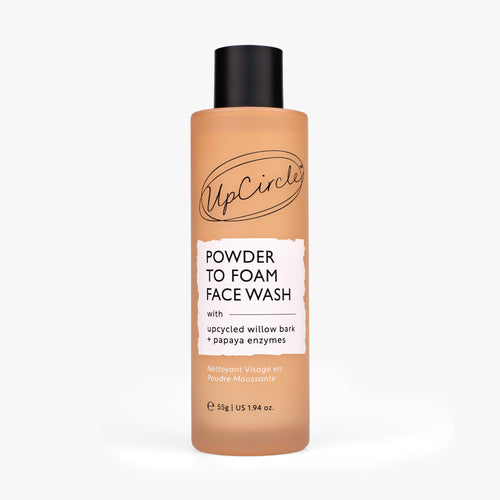
A bar removes the bottle entirely, the most complete packaging reduction available in a bathroom. Our Cinnamon and Ginger Chai Cleansing Bar and Fennel and Cardamom Chai Cleansing Bar use upcycled chai spices and work on face and body. Powders do something similar by taking out the water: our Powder to Foam Face Wash activates in your hands rather than pumping from a bottle.
The failure mode for a bar is predictable. It sits in a puddle, turns to mush, and people conclude bars do not work. They do. They need somewhere to drain, and any dish with drainage solves it. On crème versus bar versus liquid for hair, our comparison of shampoo liquid, bar or crème lays out the trade-offs without pretending one wins on every measure.
5. The small metal and bamboo tools
Unglamorous and almost impossible to wear out. A bamboo wide tooth comb replaces a plastic one and is gentler through wet hair. Cosmetic spatulas keep pots sanitary and wash indefinitely. A tube squeezer key cuts waste twice, getting the last of a product out of an aluminium tube rather than binning it half-empty, as we cover in getting every last drop out of your products. A gua sha stone and cotton wash bag round out a travel kit.
Comparison: how long each swap really lasts
Working life below is realistic rather than best case. The failure column is worth reading closely: every swap fails in a specific way, and knowing it is how you avoid it.
| Swap | What it replaces | Realistic working life | How it actually fails | Verdict |
|---|---|---|---|---|
| Safety razor | Disposable and cartridge razors | Years, with blades the only consumable | Abandoned in the first fortnight, during the learning curve | Best swap in the room, if you shave with care |
| Bamboo cotton buds | Plastic-stemmed buds | Consumable, but with no plastic stem | It does not really fail | Easiest swap on the list |
| Washable pads | Single-use cotton pads | Designed for up to 1,000 washes | Laundry backlog, then reversion | Excellent if you already wash weekly |
| Muslin cloths | Face wipes and single-use pads | Years, with hot washing | Washed too cool, then binned | Strong, low cost, low drama |
| Solid cleansing bar | Bottled wash | Weeks per bar, no bottle at all | Left in a puddle and dissolved | Works, given drainage |
| Powder face wash | Bottled liquid cleanser | Consumable, minus water and bottle | Wet hands habit takes a week | Genuine format win |
| Bamboo comb | Plastic comb | Years | Left soaking, which no wooden tool enjoys | Quietly durable |
| Metal spatulas and tube key | Plastic scoops, half-empty tubes | Effectively indefinite | Lost, not broken | Cheap, permanent, useful |
The swaps that are over-sold
Here is what to treat with more caution than the marketing suggests.
Bamboo toothbrushes described as fully compostable. The handle may well be bamboo. The bristles on most are nylon, and nylon is not compostable, so they must be pulled out before the handle goes near a compost heap. Almost nobody does that. Read the bristle material first.
Anything labelled compostable, without a check. Home and industrial composting are different processes at different temperatures, and UK kerbside collections vary by council. Find out what yours collects before buying on the strength of a label.
Bulk buys of an untested swap. The most common way a plastic-free bathroom becomes a plastic-free drawer. Buy one, live with it a month, then buy more. The same goes for replacing something that still works: finish it first.
What actually happens to bathroom plastic in the UK
Bathroom plastic is harder to recycle than kitchen plastic, and it is worth knowing why rather than assuming the bin sorts it out. The problem is rarely the bottle. It is everything attached: pumps with metal springs, mixed-material caps, foil seals, and items too small for sorting machinery.
There is real progress on the industry side. WRAP reports that UK Plastics Pact members tripled recycled content in their packaging from 8% to 28% and cut problematic plastics by 99% since 2018. That is meaningful, and specific to the businesses that signed up. For the national picture, the government publishes its waste and recycling statistics.
The takeaway is unglamorous. Recycling sits near the bottom of the waste hierarchy, and a durable object you keep for five years never enters the sorting system at all. That is why this list is framed around working life rather than recyclability. We set out our own approach in UpCircle's reusable packaging, and wrote up what we learned from the Big Plastic Count.
Five checks before you buy any swap
One: does it replace something I buy repeatedly? If it replaces nothing, it is an addition, and additions accumulate.
Two: does it change the action, or only the object? Object-only changes stick. Action changes need a reason to be worth learning.
Three: is the consumable part small, cheap and easy to get? A durable handle tied to an awkward consumable is a future abandonment.
Four: can I clean it the way I already clean things? Anything needing special treatment is a step, and steps get skipped.
Five: will it survive a wet room? Metal, glass, dense bamboo and cotton cope with humidity. Thin coatings and glued joints do not.
Where to start if you only change one thing
Start with whatever you throw away most often: usually cotton buds, cotton pads or disposable razors, and the last has the biggest gap between disposable and durable. A cartridge razor is a permanent handle tied to an expensive consumable, and a safety razor breaks that arrangement completely, which is why we would make it first.
If shaving is not part of your routine, start with buds and pads. Whatever you pick, give it a month before adding another: swaps made one at a time survive, swaps made in one enthusiastic order tend not to. For the rest of the house, see our guide to a more zero-waste home and lifestyle, and our Earth Day guide to beauty accessories that stay out of landfill goes deeper on the accessories.
Looking after your swaps so they actually last
Durability is partly the object and partly you. Let everything dry: stand the razor up so the head drains, keep bars where water runs off, hang cloths rather than folding them damp. Wash fabrics hot enough, because cool washing is why a cloth starts to smell long before it has worn out. And change blades before they drag, since a blunt blade causes the nicks people blame on the razor. Our post on how to store skincare applies the same principle to products.
Frequently asked questions
What are the best plastic-free bathroom swaps to start with?
Start with a safety razor if you shave, and with bamboo cotton buds and washable pads if you do not. These replace what most households get through fastest, and none asks you to change your routine.
Do plastic-free bathroom swaps actually save money?
Some do over a long enough period, and some do not. A safety razor costs more upfront, then far less to run, because a blade costs a fraction of a cartridge. Bars and powders can work out cheaper because you are not paying to ship water. Washable pads only save money if you were buying single-use pads often. If you were not, the saving is environmental rather than financial.
How long does a safety razor last?
The handle and head are solid metal with no moving parts to wear out, so with basic care a safety razor should last many years. Only the blade is consumed. The two things that shorten its life are sitting in water and being dropped on a hard floor.
Are bamboo cotton buds better than plastic ones?
For the same job, yes, and in England the comparison is now largely historic: the supply of plastic-stemmed buds has been banned there since 1 October 2020, when around 1.8 billion were used annually. A bamboo stem with an organic cotton tip performs identically, which is what makes the swap so reliable.
Can you recycle bathroom plastic in the UK?
Some of it, and less than most people assume. Large single-material bottles are usually easiest. Pumps, mixed-material caps, foil seals and anything small enough to fall through sorting machinery are much harder, and what is accepted varies by council, so check your local authority's list.
What plastic-free swaps are not worth it?
Anything bought in bulk before testing one, anything labelled compostable that your council does not collect, gadgets duplicating a tool you already own, and any replacement for something that still works. The last is the most common mistake: wait until the old thing runs out.
Why trust UpCircle on this
UpCircle is a certified B Corporation, so our environmental and social practices are independently assessed rather than self-declared. We have made plastic-free bathroom accessories since well before it was a category, and we deliberately sell a small range, because most bathrooms need four or five durable objects and not twenty.
We also try to be straight about the limits. This post says a safety razor has a learning curve, that reusable pads only work if you do laundry, and that replacing a working item is not a saving. None of that helps us sell more in the short term, and all of it is true. Our approach to materials is on our packaging page, and everything we make starts from rescued ingredients.
The bottom line
The plastic-free bathroom swaps that last are the boring ones. They replace something you already buy, they slot into the same moment in your routine, and they are made of materials that do not mind being wet for a decade. The novel formats and clever gadgets end up in a drawer by spring.
To read on, start with our guide to using a safety razor. To browse, our plastic-free collection and wider accessories range are where the durable objects live. And for the single highest-value change in your bathroom today, it is the Plastic-Free Safety Razor: buy it once, keep it for years, and let a small steel blade be the only thing you ever replace.