





Yes, eye rollers work, but only for the thing they are actually designed to do. A cool metal ball rolled around the eye socket gives you a genuine, short lived change in how the area looks and feels: less swollen, calmer, a bit brighter. What it will not do is remove dark circles, undo a bad night, or treat whatever is causing the shadow in the first place.
That gap between what an eye roller can do and what people hope it will do is where the disappointment lives. So here is the honest version: what the tool does to skin, what the evidence says, the correct technique and direction, whether the fridge trick is worth it, and who should skip it.
Key takeaways
- An eye roller works by combining cold and gentle massage. Both effects are real, and both are temporary.
- Rolling increases skin blood flow for a short window afterwards. In one small study, the effect lasted at least 10 minutes after a five minute massage.
- It is a look tool, not a treatment. Dark circles and under eye puffiness have structural, genetic, allergic and sleep related causes that no accessory addresses.
- Direction matters. Roll from the inner corner outwards along the bone, then out towards the temple. Never drag the skin.
- The fridge trick is legitimate and it is the official tip on our own product page. A cold tool simply holds the cooling effect longer.
Do eye rollers actually work? The honest answer
An eye roller works the way a cold compress and a two minute massage work: it changes how the area looks for a while, then the effect fades. That is not a criticism, it is the job description.
There are two separate mechanisms. The first is temperature: metal conducts well, so a metal ball pulls heat out of the skin faster than your fingertips do. The second is mechanical: rolling moves the tissue slightly and encourages fluid sitting in the area to move along.
The best available evidence for the massage half comes from a 2018 study in Complementary Therapies in Medicine, which measured facial skin blood flow before and after five minutes of rolling with a facial massage roller. Skin blood flow rose significantly on the massaged side and stayed elevated for at least 10 minutes afterwards. In a second arm, five weeks of daily use improved the blood vessels' dilation response to heat (Miyaji, Sugimori and Hayashi, 2018).
Two caveats we will not skip past. Those arms had 12 and 14 participants, which is small, and both measured the cheek rather than the under eye area, which has thinner skin and different anatomy. So it is fair evidence that rolling a face does something measurable to circulation. It is not proof that an eye roller changes your dark circles.
What an eye roller actually does to the skin around your eyes
Three things, in descending order of confidence.
1. It cools, which is the effect you feel first
Cold is the most reliable thing an eye roller offers, and it is why people reach for one at 7am rather than 7pm. A cool surface on a warm, swollen eye area feels calming immediately, and the area tends to look flatter while the cooling lasts. It is the cold spoon principle in a shape that actually fits the eye socket.
2. It encourages fluid to move
Morning puffiness is very often fluid that pooled while you were lying flat, and gentle directional massage encourages it to move along rather than sit still. Our Soothing Eye Roller has a ball shaped head so it reaches the creases and contours of the whole orbital area, which fingertips do less precisely. To be specific about the limit: the effect is on fluid distribution and how the area looks, not on anything systemic. You are not detoxing anything, and we have cut that language from how we describe this tool.
3. It spreads your eye cream evenly and slows you down
A roller applies product evenly across the whole orbital area with far less dragging than a fingertip, and it makes you spend 30 seconds on a step you would otherwise rush in three. What we will not claim is that it drives more product into the skin. "Enhances absorption" appears on a lot of tool packaging, including some of our own older copy, and we do not have evidence for it. Even application is the honest benefit.
What an eye roller cannot do
It cannot lighten pigmentation, fill hollowing, or change the shape of the fat pads under your eyes, which is largely genetics and ageing. It does nothing for the shadow cast by thin skin over visible blood vessels, which is a structural feature of your face rather than a skincare problem.
Periorbital darkness is a category, not a condition. A 2023 review in Clinics in Plastic Surgery separates it into vascular, pigmented and structural contributors, each needing a different approach and several of them needing a clinician rather than a shelf product (Treatment of Periorbital Vascularity, Erythema, and Hyperpigmentation). If you want the full breakdown of what is causing yours, we have written it up in how to get rid of dark circles and, for the product side, the best eye cream for dark circles, sorted by cause.
Same for puffiness. Fluid retention from a salty dinner behaves differently from hay fever puffiness, and differently again from a swelling that has been there for weeks. Our guide to relieving puffy eyes works through the causes properly.
How to use an eye roller: the correct technique
Most people use an eye roller like a paint roller: back and forth, too fast, too hard, straight across the softest skin on the face. Here is the version that respects the tissue.
Which direction to roll
Work outwards, from the inner corner towards the temple, following the line of the bone. Under eye first, along the orbital rim rather than on the soft centre of the lid. Then the brow bone, again inner to outer. Finish with two or three slow passes from the outer corner down towards the top of the ear. Rolling back and forth in both directions is not harmful, just less useful, because you undo the direction you just established.
How much pressure
Almost none. The skin around the eye is the thinnest on the face and does not need force. The weight of the tool plus the lightest guiding touch is correct. If the skin moves with the ball rather than the ball gliding over it, you are pressing too hard or have not used enough product. Always roll over a slip layer: eye cream, a couple of drops of face oil, or damp skin after toner.
How long, and when
Sixty to ninety seconds per eye is plenty, and daily is fine. Morning gets the most out of it, because that is when fluid has had all night to settle. Evening use is fine too, particularly after a long screen day, though the visible payoff is smaller. There is no benefit to grinding away for ten minutes: the 2018 study got its result from five minutes on a much larger area.
Where it fits in your routine
Cleanse, tone, then eye cream, then roll. Rolling over bare skin gives you the cooling without the glide, and rolling over a heavy occlusive at the end of a routine just smears it. If you are unsure of the wider order of operations, how to layer skincare correctly covers the whole sequence.
Should you keep your eye roller in the fridge?
Yes, if you want a stronger and longer cooling effect. It is the tip printed on our own product page, and there is no clever mechanism to it: a metal ball that starts at 5C takes longer to warm to skin temperature than one that starts at 20C.
Use the fridge, not the freezer. A genuinely frozen metal tool on eyelid skin is uncomfortable and unnecessary. If you are also storing product in there, our guide to storing skincare so it lasts longer covers what does and does not belong in a fridge. No fridge space? A minute under a cold tap achieves most of the same thing, and the tool is metal, so water does it no harm.
Eye roller vs gua sha vs fingers vs a cold spoon
They are not interchangeable. Here is where each one is genuinely the right choice.
| Tool | Best for | Area it suits | Cooling | Main limitation |
|---|---|---|---|---|
| Eye roller | Morning puffiness, even eye cream application | Orbital rim, brow bone, temple | Good, better from the fridge | Effect is temporary, does nothing for pigment |
| Gua sha | Jaw and cheek tension, sculpting passes | Cheeks, jaw, neck | Good | Shape is too large and firm for under eye skin |
| Fingertips | Patting product in, zero cost | Anywhere | None | Warm, less precise, easy to drag the skin |
| Cold spoon or compress | Pure cooling in an emergency | Whole eye area | Strong but very brief | No massage, no product application, awkward shape |
If you already own a gua sha stone, an eye roller is not a duplicate purchase. It is the small tool for the area the stone cannot safely reach. Our gua sha guide covers that technique, and the benefits of facial massage and the best tools to use compares the wider category.
Who an eye roller actually suits
It suits you if your main complaint is morning puffiness that settles over the course of the day, if you like the ritual of a cool tool on tired eyes, or if you find fingertip application around the eye fiddly and heavy handed. It also suits anyone building a plastic free routine, since the tool is metal, reusable and has nothing to throw away.
It suits you less if your main complaint is pigmentation rather than swelling, if your concern is hollowing, or if you are hoping a tool will replace sleep. It is deliberately a single job tool.
When to be cautious
Skip the roller if the skin around your eye is broken, if you have an active eye infection or an inflamed lid, or if you have had recent eye surgery or an injury. Persistent swelling, redness or crusting on the lid is a matter for a pharmacist or GP rather than a massage tool: the NHS has guidance on eyelid problems and blepharitis.
Sensitive and reactive skin is usually fine, because the pressure is so light, but always roll over product rather than dry skin. Our routine for sensitive skin and the Sensitive Skin Bundle are gentler starting points.
What to use with your eye roller
The roller needs a slip layer, so what you pair it with matters more than it sounds.
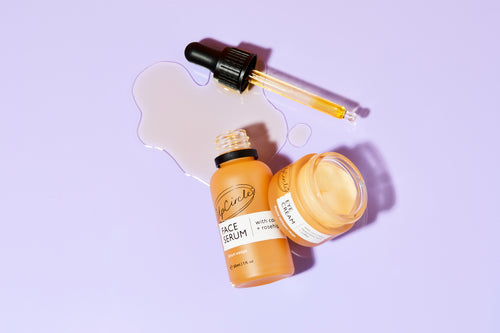
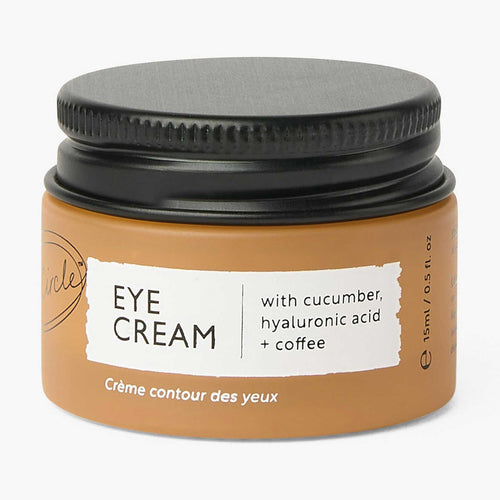
Our Eye Cream with Hyaluronic Acid and Coffee is the natural partner: hyaluronic acid is a humectant that holds water in the skin, and the upcycled coffee oil is there for the caffeine. To try the pairing first there is a 1ml eye cream sachet, and the Caffeinated Duo plus Eye Roller bundles the tool with the cream and our face oil.
If you do not use eye cream, a single drop of Organic Face Oil with Coffee Extract gives excellent glide, and damp skin straight after Face Toner with Hyaluronic Acid works on a rushed morning. Cucumber extract turns up in a lot of eye products for its soothing reputation, and we have assessed whether cucumber is genuinely good for skin rather than assuming it. The full range sits in natural eye creams, and the tool in accessories.
How to clean and look after it
Rinse the ball under warm water after each use and dry it, with a weekly wash using a little soap. Product residue is the most common reason a roller starts to drag, and metal is easy here: no absorbent surface, nothing for residue to sink into. If the ball has stopped rotating freely, dried product in the housing is almost always the cause and a soak in warm soapy water fixes it. Reusable cotton and bamboo pads dry the tool without leaving fibres behind.
When the under eye issue is not a skincare problem
Some under eye complaints have a cause no cosmetic tool touches, and they are worth naming.
Allergies are the commonest missed one. Allergic rhinitis causes congestion around the sinuses and can leave the under eye area looking shadowed and swollen, so the NHS guidance on allergic rhinitis is the right starting point if your puffiness is seasonal or worse around pets and dust. Sleep is the second: short sleep will not create a genetic shadow but it changes how tired the whole face reads, and the NHS page on sleep and health is a better use of ten minutes than any accessory.
If small firm white bumps have appeared under the eye after starting a rich cream, those are likely milia, keratin filled cysts rather than blocked pores, and they are not caused by rolling (DermNet, milium). See what milia are and how to deal with them, and do not try to roll them away. Persistent, one sided or sudden swelling around the eye should always be looked at by a GP rather than managed with skincare.
Frequently asked questions
Do eye rollers really work for dark circles?
Not as a treatment. An eye roller can make the area look temporarily brighter by cooling it and moving fluid, which helps most when the darkness is partly caused by puffiness casting a shadow. It does nothing for pigmentation or for thin skin over visible vessels, which are the two most common causes. Our dark circles guide sorts the causes out.
How long does an eye roller take to work?
You feel the cooling instantly and see the de-puffing within a minute or two. The effect is short lived. The one study that measured this found raised skin blood flow for at least 10 minutes after five minutes of rolling, so think in terms of a morning, not a week.
Should I put my eye roller in the fridge or the freezer?
The fridge. It extends the cooling effect and it is the tip we print on the product page. The freezer is unnecessary and uncomfortable on eyelid skin.
Which direction should I roll under my eyes?
From the inner corner outwards along the orbital bone, then out towards the temple and down towards the top of the ear. Use almost no pressure and always roll over eye cream or oil so the tool glides rather than drags.
Can I use an eye roller every day?
Yes. Sixty to ninety seconds per eye, once or twice a day, over a slip layer. There is no benefit to longer sessions or harder pressure, and hard pressure on this skin is the one thing genuinely worth avoiding.
Is an eye roller better than a gua sha?
They do different jobs. The eye roller is shaped for the orbital area, where a gua sha stone is too large and too firm to be used safely. A gua sha is better for the cheeks, jaw and neck. If you use both, roll the eyes and save the stone for the lower face.
Why you can trust this guide
UpCircle is a certified B Corporation and a family run British beauty brand. We build products around upcycled ingredients, raw materials rescued from other industries, and our accessories are chosen on the same basis: plastic free, reusable, and only sold if they do a job we can describe honestly.
That last part is why this guide reads the way it does. We sell an eye roller, and we could have told you it treats dark circles. Instead we cited the one decent study that exists, flagged that it was small and measured the cheek rather than the eye, cut the absorption claim from our own copy, and pointed you at NHS guidance for the situations where a cosmetic tool is the wrong answer. Efficacy first, evidence attached, or we do not say it. Our FAQ page covers the rest.
Where to go next
Read more: if you want the cause level detail this article deliberately points away from, start with how to relieve puffy eyes and the best eye cream for dark circles.
Explore the range: browse our natural eye creams and the wider plastic free accessories if you are building the routine rather than buying one thing.
Shop the tool: the Soothing Eye Roller is plastic free, reusable, and shaped for the whole orbital area. Keep it in the fridge, roll outwards, use almost no pressure, and expect a good morning rather than a cure.