


Categories

Popular Products
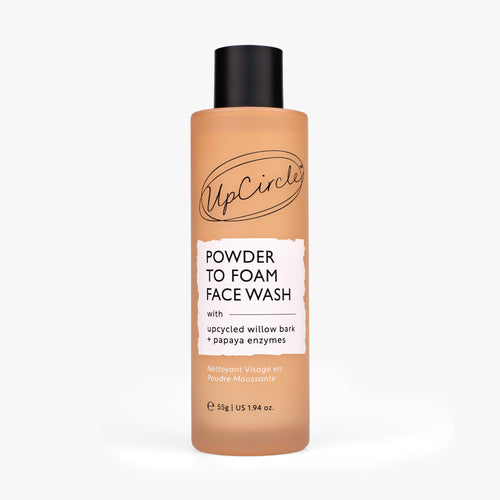
Powder to Foam Face Wash with Willow Bark + Papaya Enzymes
£21.99
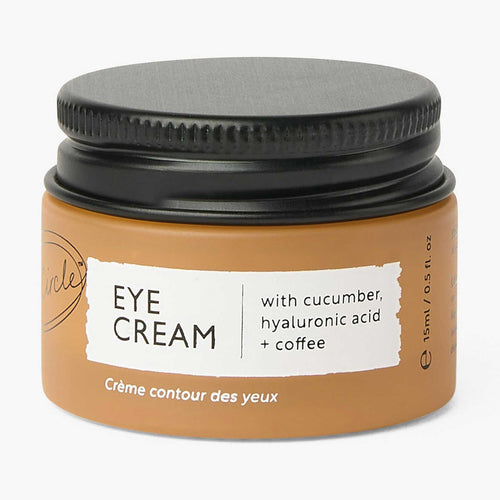
Eye Cream with Hyaluronic Acid + Coffee
£23.99
"Pamper + Gift" Skincare Kit
£20.00£29.99
SPF 25 Mineral Sunscreen
£19.99£27.99


 30,000+ 5-Star Reviews
Last updated: Oct 6, 2025
And it's opening up faster than anyone told you.
I formulate skincare for a living. Here is the part nobody explains: the slackness you see along your jaw isn't your skin stretching out. It's two things inside it drifting apart. Keep reading and I'll show you exactly what's moving, and why the cream on your bathroom shelf can't reach it.
Words by

Share


Published on: Oct 7, 2025

Picture two points inside your skin.
Not on the surface. Underneath, in the layer that holds everything up. These two points are anchored to each other. That connection is what makes young skin bounce back when you press it.
Now pull them apart.
Just slightly. A fraction of a millimetre. Then again next month. Then again the month after.
Nothing dramatic happens on any given day. But the gap doesn't close on its own.
And a few hundred of those tiny gaps, across your cheeks and along your jaw, is exactly what you're looking at in the mirror when you say your face looks like it's sliding.
That's it. That's the whole thing.
Your skin isn't getting looser. It's getting further apart.
Once you know that, a lot of things start making sense. Why the slackness showed up so suddenly. Why it appeared along the jaw first. Why it didn't respond to anything you tried. And why it felt less like ageing and more like something coming apart.
"I kept saying my face looked tired. It wasn't tired. It was coming apart by degrees and I had no language for it."
Customer review, verified
15% Off

Contains the Peptide Serum + Powder to Foam Face Wash + Cooling Gel Moisturiser
THE FOUR-SECOND TEST
Before you read any further, do this.
Press the pad of your finger into your cheek, just below the cheekbone. Push in gently. Then let go and watch.
Count how long it takes for the dent to disappear completely.
At twenty-five, it's instant. You wouldn't even notice it happening.
At forty-five, there's a beat. A fraction of a second where the skin is still deciding.
At fifty-five, there's more than a beat. Sometimes you can watch it come back.
That beat is the gap. You just measured it.
It isn't hydration. You can drink three litres of water and drown your face in hyaluronic acid and the beat will still be there tomorrow. It's structural. It's the distance between two anchor points that used to sit closer together, and the time your skin now needs to pull itself back across that distance.
Do the same test on the inside of your forearm, where the skin has had far less sun and far less movement. Most women find the difference startling.
🔬 So what's pulling them apart?
Two proteins run that structure. Collagen holds it firm. Elastin lets it spring back.
Your body makes less of both every year after about twenty-five. Slowly. Boringly. You don't notice, because a 1% change against last year is invisible against a face you see every single morning.
Then your hormones change, and slow becomes sudden.
In the first few years around menopause, women lose roughly 30% of their skin's collagen. Not over a lifetime. In a handful of years. Elasticity then keeps falling at around 1.5% a year after that.
Sit with those numbers for a second, because they explain something that has probably been bothering you.
A third of the structural protein in your face, gone in the time it takes to change jobs twice. That is not a gentle slope. That is a cliff, and you walked off it without being told it was there.
Which means the change you noticed last spring was real, it was fast, and it wasn't your imagination.
It also wasn't your fault. You didn't stop looking after your skin. You didn't get lazy. The supply of the thing holding it together dropped out from under you, and no product you owned was built to notice.

THE FOUR THINGS HAPPENING AT ONCE
📉 Here's what's going on under the surface:
🔹 Collagen production falls. The scaffolding gets sparser. Skin that used to feel dense starts to feel thin. You notice it first along the jaw and the cheeks, because that's where there's the least underneath to hold things up.
🔹 Elastin stops recovering. That's the four-second test. Young skin snaps back immediately because the elastin network pulls it back. Depleted elastin takes its time, and then eventually stops pulling all the way back at all.
🔹 The barrier weakens. Oil production drops. The skin holds less water. You get tight by mid-morning no matter what you put on at seven, and by evening it feels like it's shrunk a size.
🔹 Reactivity goes up. Here's the part that catches everyone out. The same barrier that stopped holding water also stopped keeping things out. Products you used for a decade start to sting. Retinol that was fine at forty leaves you flaking at forty-eight.
Read that last one again, because it's the cruel part.
Your skin became more fragile and more visibly aged at exactly the same time.
Which is why every product strong enough to do something now hurts, and everything gentle enough to tolerate does nothing. It isn't bad luck and it isn't you picking badly. It is a genuine bind, and almost nothing on the shelf is designed to solve both halves of it at once.
🧪 43% of American women over 45 are actively searching for skincare made for what their skin is doing right now.
Most of them will be sold a richer moisturiser and told it's normal. Almost none of them will be told what's physically happening, or why the moisturiser won't touch it.
WHERE ARE YOU ON THIS?
There are three stages to this, and most women can place themselves in about ten seconds.
Stage one. Connected. The anchor points sit close together. Press your cheek and it springs straight back with no delay. Your face looks the same lying down as it does standing up. Nothing to fix yet.
Stage two. The gap opens. The beat appears. Makeup starts settling into places it never used to. Your face looks noticeably better first thing in the morning, before gravity has had a full day at it. Photographs taken from below start to bother you and you don't quite know why. Most people arrive here somewhere between forty-two and fifty, and most people blame it on being tired.
Stage three. Visible slack. Enough gaps have opened that the surface has nothing holding it taut. The jawline softens. The area either side of the mouth starts to drop. You begin angling the camera upward without consciously deciding to.
Most women reading this are somewhere between two and three.
The useful news is that two and three respond to the same thing, because it's the same mechanism at a different stage. Nothing has broken. The distance has just grown.
15% Off

THE TURN
So here's the real question.
If the gap is the problem, why hasn't a single moisturiser you've ever bought closed it?
Because a moisturiser isn't built to. A moisturiser works on the top layer. It adds water, it seals it in, it makes the surface feel soft and look plumper for a few hours.
That's a genuinely useful job and a good one does it well. I formulate them. I'm not about to tell you they're pointless.
But it's happening on top of the gap. Not across it.
Think about what that means for a second. You can hydrate a surface every morning and every night for twenty years, and in all that time never once send a single instruction to the structure underneath. The water goes in.
The surface swells slightly. By evening it's gone. Nothing beneath it has changed at all.
That's not a flaw in your routine. It's a category mistake, and almost all of us have made it, including me, for longer than I'd like to admit.
And it explains the thing that probably frustrates you most: why the expensive cream and the drugstore cream produced roughly the same result. They were both working on the wrong layer. Price doesn't fix an address problem.
🧪 That's why we keep buying richer creams, layering more steps, and wondering why nothing holds.
We've been treating a structural problem with a surface product.
The gap is underneath. The answer has to reach it.

WHAT CROSSES THE GAP
Here's what I was actually trying to solve when we formulated this.
You can't manufacture new collagen in a bottle and push it into someone's face. The molecule is far too large to get anywhere near the layer that needs it. Anyone selling you a collagen cream for firmness is selling you something that stops at the front door.
But you can send the instruction.
That's what a peptide is. A short chain of amino acids that your skin already speaks the language of. Not a foreign substance your face has to tolerate and eventually rebel against. A message, written in a format your skin recognises, telling it to get back to work.
Ours is a biomimetic tripeptide. Biomimetic means it imitates. Three peptides linked together, built to look almost exactly like amino acids already sitting in your skin.
That matters more than it sounds like it does. When most active ingredients meet your skin, your skin has to decide whether to accept them. Sometimes it decides no, and that decision is what redness and stinging actually are. A biomimetic peptide skips the argument entirely. Your skin doesn't recognise it as an intruder, because structurally it isn't one.
So it doesn't bounce off. It anchors.
And then it does the thing that matters.
Remember the two points that drifted apart? The peptide anchors to one and reaches across to the other.
It works as a bridge.
Not filling the gap from above. Not sitting on top of it and hoping. Spanning it. And once that span exists, it signals the skin to build across it properly, using its own collagen, made by its own machinery, in its own time.
That's the whole mechanism. A gap opened. Something reached across it. The structure rebuilt along the line.
15% Off


WHY THIS IS THE GENTLE ROUTE
Here's the part that surprises people.
The reason this doesn't sting is the same reason it works.
Retinol and acids get results by provoking your skin. They speed up turnover, strip the surface, force a response. It's effective and it's well-evidenced and it is also, unavoidably, an argument with your face. If your barrier is strong, you win that argument and get smoother skin. If your barrier is thin, which it now is, you lose it and spend four days recovering.
Peptides don't work that way at all. There's no provocation, no stripping, no turnover being forced. Just a message your skin already knows how to read. Peptides don't photosensitise either, which is why you can use this in the morning under SPF without a second thought.
So gentleness here isn't a consolation prize for people who can't handle the strong stuff. It's a direct consequence of the mechanism.
That's also why it sits comfortably alongside things you already use. It doesn't compete with retinol. It doesn't cancel out vitamin C. It doesn't need its own night of the week.
THE PROOF
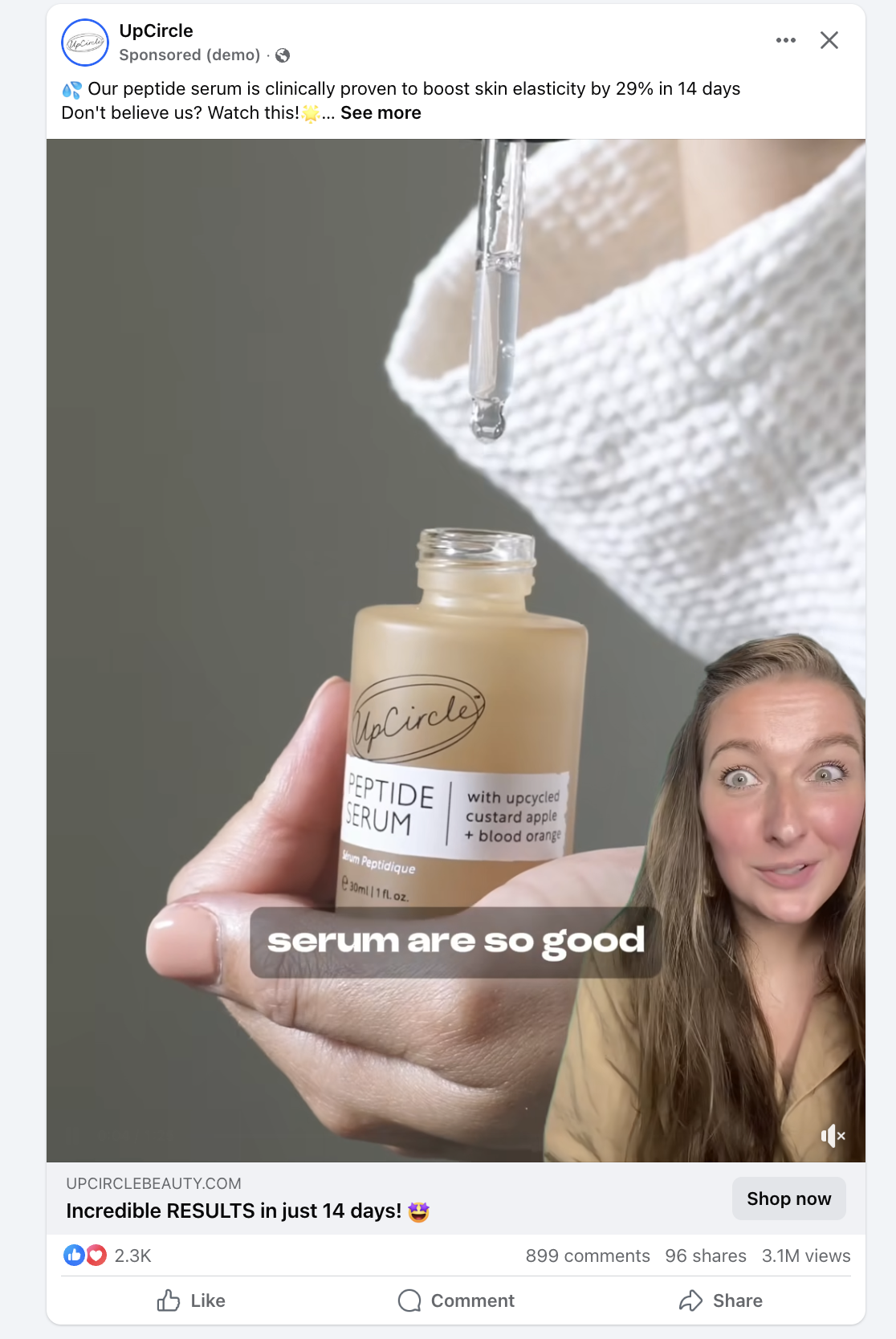
That's the theory. Here's what happened when we tested it.
We ran a clinical study on 22 women, over 14 days. Each woman acted as her own control, so we were measuring the same face before and after rather than comparing one group of people against another. That design matters, because it removes the biggest variable in skincare trials, which is that everybody's skin is different to begin with.
We measured elasticity with an instrument. Not a questionnaire, not a panel of women saying whether they felt their skin looked nicer.
📊 Elasticity improved by 29.42%.
The statistical result was p = 0.0007. If that means nothing to you, here's the translation: there is roughly a 1 in 1,400 chance that result happened by luck.
For context, published peptide research generally reports somewhere between 10% and 20% improvement in elasticity over twelve weeks.
We measured 29.42% in fourteen days.
Two things I'll say plainly, because I've been formulating long enough to be suspicious of numbers like that, including my own. Twenty-two women is a small study. It's real, it's instrumented, and the elasticity result is statistically solid, but it isn't a thousand-person trial and
I'm not going to dress it up as one. We measured brightness too, and it didn't reach significance. Plenty of customers report a glow and you'll see them say so below. I'd rather you hear that from them than from a graph that doesn't quite hold up.

Many women, including those navigating perimenopause and menopause, have shared their results proudly — posting photos with their Peptide Serum as their “confidence bottle.” These real customers celebrate firmer, brighter, more resilient skin, proving that age and hormonal changes don’t define how radiant you can look.
WHAT'S IN IT
Four things do the work.
🔹 Biomimetic Tripeptide-1. The bridge. Recognised by your skin, signals collagen production, works at low dose because of how active it is. This is the ingredient the clinical result belongs to.
🔹 Niacinamide. Third ingredient on the list, which tells you there's a meaningful amount of it rather than a trace. Strengthens the barrier that stopped holding water. If your skin has gone reactive, this is the ingredient working on that.
🔹 Stable vitamin C (3-O-Ethyl Ascorbic Acid). A more stable form than pure ascorbic acid, which means it doesn't oxidise into uselessness in the bottle. Antioxidant protection and tone.
🔹 Upcycled custard apple. Calms inflammation and builds resilience. It's the reason the formula tolerates skin that has become easily provoked.
And then there's the water.
Most serums are mostly water. Ours isn't. The second ingredient on our list is upcycled blood orange extract, rescued from the non-edible parts of fruit the food industry was about to discard.
That's not a sticker on the box or a nice line in the founder story. It's the base of the formula. The thing every other ingredient is suspended in is a rescued by-product doing an active job.
93% natural ingredients. Fragrance-free. Vegan. Housed in glass.
No parfum, no parabens, no silicones, no mineral oil, no palm oil.

The custard apple comes from Ecuador, Peru and Colombia. The blood orange from the Mediterranean. Both are rescued from food production, from the parts of the fruit that never make it to a supermarket.
That's the whole company, really. Ten years ago my colleagues Anna and Will worked out that more than 500,000 tonnes of coffee grounds go to UK landfill every year, and started collecting used grounds from London cafés to put into skincare. Since then we've saved 450 tonnes of coffee and rescued ingredients from the argan, tea, juice, olive, date and wood industries.
The point was never that upcycled sounds good on a label. It was that a by-product is often the most active part of the plant, and everyone was throwing it away.
15% Off
THE ROUTINE
1. Cleanse. Powder to Foam Face Wash. Soap-free, pH 5.5, turns from a silky powder into a soft foam the moment it meets water. Lifts off makeup and SPF without that tight, squeaky feeling.
2. Treat. Peptide Serum. Two or three drops onto damp skin. That's the full dose. It's meant to be watery and it's meant to disappear. If it feels like you've barely applied anything, you've done it right. Damp skin matters here: it gives the formula something to carry it in.
3. Cool. Ceramide Gel Moisturizer. A gel, not a cream. Cools on contact, sinks in with no film and no shine, and leaves nothing for your SPF or makeup to fight with.
Morning and night. About sixty seconds, start to finish.
On order: serum before moisturiser, always. The serum is the instruction. The moisturiser is what keeps the surface comfortable while the instruction is being carried out. Put the moisturiser on first and you've built a wall in front of your own message.
And don't skip step three. The serum is not a moisturiser and was never designed to be one. It's watery, it goes underneath, and on its own it won't keep dry skin comfortable through the day. That's the moisturiser's job. The two work as a pair.
WHY THESE THREE
✅ Gentle at every step. Soap-free cleanse, fragrance-free serum, fragrance-free gel. Nothing in this routine is designed to tingle.
✅ Light on warm skin. A powder, a watery serum, a cooling gel. No heavy creams anywhere, which matters if your face runs hot or flushes easily.
✅ Peptides twice. Tripeptide-1 in the serum, upcycled maca root peptides in the moisturizer.
✅ Barrier support built in. Encapsulated ceramides, plus panthenol, allantoin, glycerin and niacinamide across the three.
✅ Circular by design. Willow bark, rice lees, custard apple, blood orange, bilberry seed and maca root are all upcycled by-products.
✅ 30 days to change your mind. If it isn't right for your skin, pick anything else from our range and we'll send it free.
⭐️ 4.8 · 1,333 reviews
⭐️⭐️⭐️⭐️⭐️ "I am 41 and have a few deepening lines on my forehead and between my brows. You could feel the indents with your fingers. Now when I feel the skin there you can barely feel anything. Everything has plumped up from the inside."
⭐️⭐️⭐️⭐️⭐️ "On Monday, my hairdresser asked if I'd had botox."
⭐️⭐️⭐️⭐️⭐️ "I'm in my 50s and since the menopause my skin has been hyper sensitive but there are undeniable signs of aging. It's amazing. My skin looks smooth and plumper and no irritation or break outs."
⭐️⭐️⭐️⭐️⭐️ "Getting lots of compliments too. Not something you expect at 55."
⭐️⭐️⭐️⭐️⭐️ "I'm 67 and since using it I have noticed the elasticity."
⭐️⭐️⭐️⭐️⭐️ "My Dad even told me how nice my skin looked and he doesn't know what I do or use and he never comments on my skin."
⭐️⭐️⭐️ "I've been using it 3 weeks now and haven't noticed a difference. I'll keep using it and hopefully a change but it's a lot of money if not."
⭐️⭐️⭐️⭐️⭐️ "I initially bought it as a travel size and could see the difference in my skin when I ran out. Have bought the full size since. Non greasy and doesn't aggravate peri menopause acne."
⭐️⭐️ "Been using this for a couple of weeks and my skin has broken out. I have stopped using it."
⭐️⭐️⭐️⭐️⭐️ "As I'm 74 it's going to have to work hard but so far the signs are good."
⭐️⭐️⭐️⭐️ "So far so good, skin feels tighter and starting to see results. Only issue is the smell isn't fabulous."
⭐️⭐️⭐️⭐️⭐️ "It's only been two weeks and I can already see an improvement. I've had a few of my friends comment on how nice my skin looks."
⭐️⭐️⭐️⭐️⭐️ "Initially I felt like I was using too much of this as it just disappeared into my skin. After a week, I used less and then less as my skin has transformed. It has reduced redness, plumped and made me feel more confident."
THIRTY DAYS. THEN DECIDE.
You've read a lot of confident language on this page, so here's the part where I stop asking you to take my word for it.
Use it for two weeks. That's the window we measured in the study. Then do the four-second test again, on the same cheek, in the same light.
Give it another two weeks after that, because skin doesn't run to a schedule and some people take longer.
If at the end of thirty days it hasn't done what you hoped, tell us and pick anything else from the range. We'll send it free. Not a voucher. Not store credit with conditions. Any product you like, on us.
We do it that way because a refund gets you your money back and leaves you exactly where you started, which is still looking for something that works. This way you end up with something that suits your skin, which was the point of the whole exercise.
I'd rather that than another half-used bottle sitting in someone's bathroom cabinet. There are enough of those already, and most of them are my industry's fault.
→ TRY IT FOR 30 DAYS
15% Off
FAQ
Where does it go in my routine? After cleansing, before moisturizer and SPF. Two or three drops onto damp skin. If you use a toner, spritz first and apply the serum while your face is still damp.
Can I use it with retinol? Yes. Peptides don't compete with retinol and don't photosensitize. Many people use the serum in the morning and retinol at night.
It feels really watery. Is that right? Yes. It's a water-based serum with no oils and no silicones, so it disappears fast. That's the design. If it felt rich it would be sitting on top of your skin instead of sinking into it. Two or three drops is a full dose, not a small one.
Is it fragrance-free? Yes. There's no added parfum. What you can smell is the raw formula, mostly the blood orange extract. Some people love it, some don't. It fades within about a minute.
I have sensitive skin. Is it safe? It's gentle enough for most sensitive skin and it's fragrance-free, which removes the most common trigger. As with any active ingredient, we'd always suggest a patch test on your inner arm for 24 hours first. And if it turns out not to suit you, you've got thirty days to swap it for something that does.
Will it get rid of my forehead lines? It works on elasticity and firmness, which is what softens the look of fine lines and restores bounce. A deep line that's been set by decades of the same expression is a different problem, and I'd rather tell you that now than have you disappointed in a fortnight.
How long until I see something? Most people notice hydration immediately and firmness building over two weeks. Our study measured 29.42% at day 14. Some people take longer, which is why the swap window runs to thirty days rather than fourteen.
Is this an anti-ageing product? It targets loss of elasticity, which is one of the things people mean by ageing. We're not going to tell you your face is a problem to be solved. We will tell you what the ingredient does and let you decide whether you want it.
What if I don't like it? Tell us within thirty days and choose anything else from our range. We'll send it free. No forms and no explanation needed.
15% Off
Contains the Peptide Serum + Powder to Foam Face Wash + Cooling Gel Moisturiser

